APFC 27 · Milwaukee · December 13 · Landmark Credit Union LiveTickets and the card
West Allis

The disciplines

Boxing

DRAFT 2026-11-04. Facts carry URLs. Level assignments, the ladder map, the class plan and the kids program are PROPOSALS for Anthony Pettis to rule.

Hands up. Chin down. Feet first.

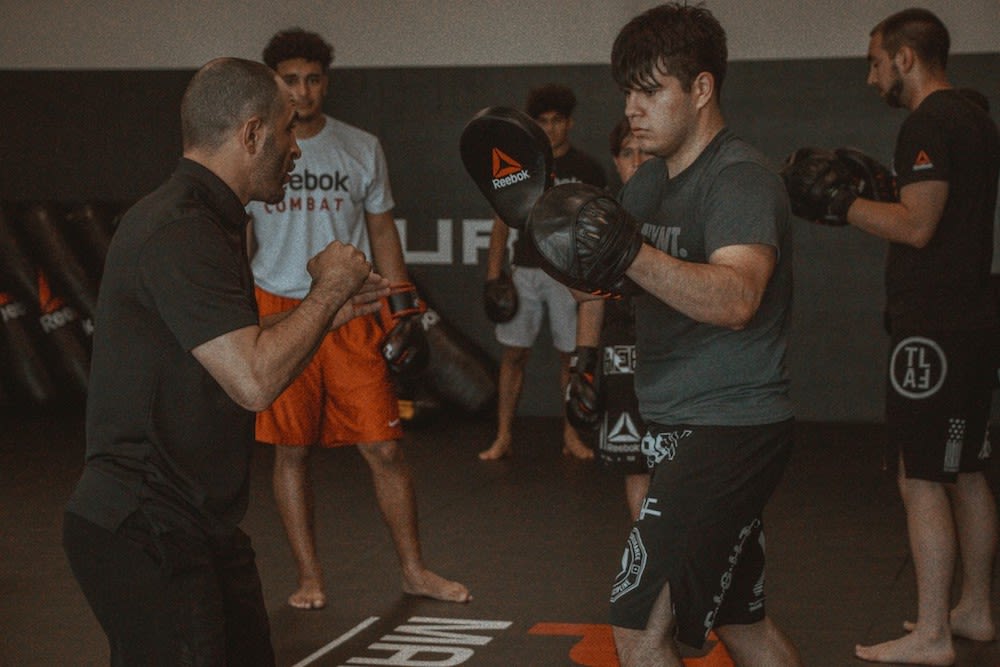
Boxing is striking with the fists only. A boxer learns straight punches, hooks and uppercuts from a balanced stance. Footwork controls the distance. Blocks, parries, slips and ducks answer the punches. The rules reward clean blows landed with the knuckle surface of the glove on the target area (USA Boxing Rule 14.6, https://www.usaboxing.org/usa-boxing-rulebook). The art is taught in a fixed order: stance and steps first, then the straight punches and their defenses, then hooks, uppercuts, feints and counters, then technique sparring, conditioned sparring and open sparring (Boxing Canada Club Coach manual, Tables 7.8 to 7.12 and Chapter 5, https://www.fqbo.qc.ca/modules/publications/Club%20Coach%20manual%20-%202016,%20June%2015.pdf). In the United States, USA Boxing governs amateur competition by age, weight and experience class (https://www.usaboxing.org/usa-boxing-rulebook).

The disciplines

Where it comes from

  1. 688 BCE

    Boxing was contested at the ancient Olympic Games; the first known ancient Olympic boxing champion, Onomastos of Smyrna, won in 688 BCE and 684 BCE.

    olympedia.org
  2. 1719

    James Figg is recognized as the first boxer to be called a heavyweight champion.

    bbbofc.com
  3. 1743

    Jack (John) Broughton formulated the first set of boxing rules; Broughton's Rules governed boxing until 1838.

    bbbofc.com
  4. 1838 and 1853

    The original London Prize Ring Rules were devised, based on Broughton's rules; the revised London Prize Ring Rules followed in 1853.

    bbbofc.com
  5. 1865 to 1867

    The Queensberry Rules, written by John Graham Chambers and publicly backed by John Sholto Douglas, the 9th Marquess of Queensberry, were drafted in 1865 and published in 1867: fair-sized gloves of the best quality, three-minute rounds with a one-minute rest, and ten seconds for a fallen boxer to rise unassisted. The twelve rules themselves do not set weight divisions; weight classes developed in the gloved era that followed. The WBA dates adoption to 1865 and notes some sources argue 1867; Encyclopedia.com says published 1865; the British Boxing Board of Control dates Chambers' draft to 1857.

    wbaboxing.com
  6. 1889

    John L. Sullivan won the last sanctioned bare-knuckle championship fight, against Jake Kilrain.

    bbbofc.com
  7. September 7, 1892

    Sullivan lost the world heavyweight championship to James J. Corbett in New Orleans, fought with gloves under the Queensberry Rules.

    bbbofc.com
  8. September 21 to 22, 1904

    The first Olympic boxing tournament was held at Washington University's Physical Culture Gymnasium in St. Louis: seven weight classes, amateurs only, United States entrants only.

    olympedia.org
  9. 1912

    Boxing was left off the Stockholm Olympic program because the sport required special permits in Sweden at the time.

    olympedia.org
  10. 1920

    Official foundation of the International Amateur Boxing Federation (FIBA).

    iba.sport
  11. 1923

    Arch Ward, sports editor of the Chicago Tribune, ran the first Golden Gloves tournament in Chicago; 424 boxers competed.

    chicagogoldengloves.org
  12. November 29 to 30, 1946

    The Association Internationale de Boxe Amateur (AIBA) was founded.

    olympedia.org
  13. 1974

    First AIBA Men's World Boxing Championships, Havana, Cuba.

    iba.sport
  14. 2001

    First AIBA Women's World Boxing Championships, Scranton, USA.

    iba.sport
  15. 2012

    Women's boxing made its Olympic debut at London 2012.

    olympedia.org
  16. 2013

    AIBA removed headguards from elite men's competitions.

    iba.sport
  17. December 2021

    AIBA was renamed the International Boxing Association (IBA).

    olympedia.org
  18. April 2023

    World Boxing, a new international federation, was publicly launched; by January 2025 it had approved 60 national federations.

    worldboxing.org
  19. February 26, 2025

    The IOC Executive Board granted World Boxing provisional Olympic recognition.

    worldboxing.org
  20. January 1, 2026

    The current USA Boxing National Rule Book took effect (the 2025 edition had taken effect January 1, 2025). USA Boxing is recognized by the USOPC as the National Governing Body for amateur, Olympic-style boxing.

    usaboxing.org
  21. May 13, 2026

    World Boxing announced that the IOC had approved the Olympic qualification system for the boxing competition at LA28: 248 places, seven weight classes each for men and women, with the 2027 World Boxing Championships in Kazakhstan as the first qualifier. The page does not give the date of the IOC decision itself.

    worldboxing.org

The disciplines

How it works

  1. Balance before everything: nearly all boxing skills depend on the stability of the stance, governed by the base of support (the feet) and the position of the center of gravity, so the boxer flexes the knees and keeps one foot ahead of the other (Boxing Canada Club Coach manual 3.2, https://www.fqbo.qc.ca/modules/publications/Club%20Coach%20manual%20-%202016,%20June%2015.pdf).
  2. Three fundamentals, offense, defense and footwork, are introduced before anything else (manual, Table 7.3).
  3. Learn the attack, then its defense: every skills table notes that the boxer must first learn the attacking move and then the associated defense (manual, Tables 7.9 to 7.12).
  4. Straight punches first, in a fixed order: fundamental skills (feet, steps, stance, mechanics of the straight punches), then basic skills (jab, straight power punch, their defenses, straight combinations, shadow boxing), then intermediate skills (slips, parries, feints, hooks, uppercuts) (manual, 7.5 and Tables 7.8 to 7.12).
  5. Rhythm and balance make combinations: only the last one or two punches of a combination are thrown at maximal intensity, and the feet follow the opponent to stay in range (manual, 3.9).
  6. Economy of movement: the pivot on the ball of the front foot cuts off ring space with minimum energy and makes the opponent spend more (manual, 3.4).
  7. Eight tactical principles: intent and purpose, surprise and deception, effective use of space and time, consolidation, commitment, calculated risk, exploitation of the opponent's weaknesses, economy of energy (manual, 4.3).
  8. Clean blows win rounds: a scoring blow connects cleanly with the target area, carries the weight of the body or shoulder, lands with the knuckle surface, breaks no rule and is seen by the judge; quantity counts first, then quality, then technical and tactical superiority (USA Boxing Rule 14.6, https://www.usaboxing.org/usa-boxing-rulebook).
  9. Sparring is staged and is training, never a show: technique sparring, then conditioned sparring, then open sparring (manual, 5.3); USA Boxing defines sparring as training under a registered coach at a training facility and prohibits sparring as entertainment (rulebook, Definitions).
  10. The head is protected by rule: a knockout or stoppage from head blows brings a mandatory rest period that also bars training and sparring, and the coach must report any knockout or concussion in training (USA Boxing Rule 5.4).

The disciplines

The techniques, by level

26 of 26 techniques

Boxing stance (orthodox or southpaw)

Level 1 Foundation

Feet apart with one foot ahead, knees flexed, hands up, center of gravity inside the base of support (manual 3.2).

At APFC
Foot placement first with hands lowered or on the hips, then bounding on the toes with exaggerated ankle and knee bend, then the full stance, checked in the gym mirror (manual Table 7.8).

Boxing steps (forward, backward, lead-foot side, rear-foot side)

Level 1 Foundation

The four directional steps that move the whole stance without crossing the feet (manual Table 7.8).

At APFC
Steps on the coach's signal (voice, hand, whistle); in pairs with arms on the partner's shoulders; then in pairs keeping distance (manual Table 7.8).

Circling right and left

Level 1 Foundation

The third and fourth of the four basic moves: advancing, retreating, circling right, circling left (manual 3.3).

At APFC
Part of the normal shadow-boxing routine with mirror checks of balance and hand position (manual 3.2).

Side-step

Level 2 Technique

Front foot moves back toward the rear foot, the boxer steps off to the rear-foot side and pivots back into stance, taking the head off the line of the jab (manual 3.3).

At APFC
Introduced after the four basic moves are mastered; practiced in pairs, taking turns shifting out of the partner's advance (manual 3.3).

Pivot

Level 2 Technique

Weight on the ball of the front foot, a half-circle rotation that cuts down ring space (manual 3.4).

At APFC
Drilled after the side-step; described as relatively simple to learn (manual 3.4).

Circling away from the rear hand

Level 2 Technique

Footwork that keeps the boxer away from the opponent's power hand (manual Table 7.10).

At APFC
Listed in Intermediate Boxing Skills 1 after the basic defenses (manual Table 7.10).

Jab to the body

Level 2 Technique

The straight lead punch to the body (manual Table 7.9).

At APFC
After the jab to the head and its defense, in place and in motion, then in the combination jab head, jab body (manual Table 7.9).

Straight power punch to the head (cross)

Level 1 Foundation

The straight rear-hand punch (Encyclopedia.com; manual Table 7.9).

At APFC
After the jab; in place, then in motion, then in combinations such as jab and straight power punch to the head and double jab and straight power punch (manual Table 7.9).

Straight power punch to the body

Level 2 Technique

The straight rear-hand punch to the body (manual Table 7.9).

At APFC
After the straight power punch to the head; combined with the jab to the body (manual Table 7.9).

Double jab and straight combinations

Level 2 Technique

Double jab; jab head and jab body; jab and straight power punch to head or body (manual Table 7.9).

At APFC
Individual repetitions at low speed, then the heavy bag, then pads or the partner's gloves held at the center of the body, then the coach jabbing with a glove so the boxer slips into range and counters, then sparring (manual 3.9).

Lead hand hook to the head

Level 2 Technique

A bent-arm blow thrown from outside the line of vision, mainly as a counter or in a combination (manual 3.5).

At APFC
Weight to the rear leg, explosive pivot at hips and shoulders, front foot pivoting inward, front arm relaxed in a hook shape, rear knuckles on target with the palm facing the floor, rear hand kept high (manual 3.5).

Lead hand hook to the body

Level 3 Conditioning

Strictly a counterpunch to the solar plexus or liver, sometimes called a lead uppercut because of its steep angle (manual 3.7).

At APFC
Constant precision practice because a careless low hook can bring a warning or disqualification; front foot placed inside the opponent's lead foot (manual 3.7).

Rear hand uppercut (head and body)

Level 3 Conditioning

A medium or short range counter, especially against a crouching opponent (manual 3.10).

At APFC
Weight over the rear side, forearm parallel to the floor with palm up, explosive hip and shoulder rotation, back knuckles on target, lead hand high; drilled with the coach or partner advancing with a pad while the boxer retreats, anchors the back foot and snaps the uppercut; never telegraphed (manual 3.10).

Lead hand uppercut (head and body)

Level 3 Conditioning

The short upward lead-hand punch (manual Table 7.12).

At APFC
Individually and with a partner, after the rear hand uppercut (manual Table 7.12).

Combinations with hooks and uppercuts

Level 3 Conditioning

Jab, straight power punch, lead hook; rear uppercut to the body then lead hook to the head (manual 3.13 and Table 7.11).

At APFC
The first punches confuse the opponent so the last finds the opening; the slip against the jab is built into the sequence (manual 3.13).

Feints

Level 3 Conditioning

A faked jab or straight power punch that draws a reaction before the real punch (manual Table 7.10).

At APFC
Feint jab then straight power punch to the head; feint straight power punch to the body then jab to the head; feint jab to the body then straight power punch to the head (manual Table 7.10).

Counterpunching with the straight power punch

Level 3 Conditioning

The rear hand thrown immediately in response to the opponent's lead (manual Table 7.9).

At APFC
After a block or parry; the coach leads with a glove and the boxer slips into range to deliver (manual 3.9).

Diversionary (blind) jab

Level 4 Competitor

A jab thrown to distract before an attack (manual Table 7.10).

At APFC
First item of Intermediate Boxing Skills 1 (manual Table 7.10).

Covering up (high guard)

Level 1 Foundation

Gloves and forearms closed in front of the head and body under attack (manual Table 7.9).

At APFC
Last of the basic skills, used against combinations of straight punches (manual Table 7.9).

Forearm block

Level 1 Foundation

Blocking the blow with the forearm, elbow tucked to protect the body, open glove held slightly away from the head to avoid a jarring effect (manual 3.6).

At APFC
The first defense children meet (basic block against straight punches, manual Table 7.3), later with an immediate counter to head or body (manual Table 7.10).

Elbow block

Level 2 Technique

Against hooks or uppercuts to the body: pivot at the waist and turn the body to meet the punch with the elbow, arms not moving, chin down (manual 3.8 and 3.12).

At APFC
Taught with the lead hook to the body and the uppercuts as their associated defense (manual Tables 7.11 and 7.12).

Parry

Level 2 Technique

Deflecting a jab or straight power punch with the glove, in place or in motion, including the front-to-rear parry against a rear-hand lead (manual Table 7.10).

At APFC
Intermediate Boxing Skills 1, in place then in motion (manual Table 7.10).

Slip

Level 2 Technique

Moving the head off the line of a straight punch: to the rear-foot side against the straight power punch, to the front-foot side against the jab (manual Table 7.10 and 3.13).

At APFC
Intermediate Boxing Skills 1, then built into counters and combinations (manual Table 7.10 and 3.13).

Duck, rotary duck, sway back and step back

Level 2 Technique

The duck bends slightly forward from the waist and flexes the knees to drop the head under a hook with hands high, chin down and eyes on the opponent; the rotary duck answers the lead hook; sway back and step back take the head out of range of straight punches (manual 3.6, Tables 7.10 and 7.11).

At APFC
Ducking from short, medium and long range; sway back and step back in place then in motion (manual 3.6 and Table 7.10).

Lead hand block against the rear uppercut

Level 3 Conditioning

The lead hand drops just enough to catch the uppercut before the chin while the rear hand stays high (manual 3.11).

At APFC
Taught as the associated defense of the rear hand uppercut (manual 3.11 and Table 7.12).

The disciplines

The rules

amateur

Governing body USA Boxing (USOPC-recognized National Governing Body, 2026 bylaws), National Rule Book effective January 1, 2026. Age classes (Rule 7.1, age by year of birth): Prep 8 to 14 with Pee Wee 8 to 10 (8-year-olds box only 8- and 9-year-olds at club events, minimum age 8 by actual birth date, age range in a Prep competition at most two years), Bantam 11 to 12, Intermediate 13 to 14; Junior 15 to 16; Youth 17 to 18; Elite 19 to 40 (18-year-olds may opt in at advancing national events); 35 to 40 declare Elite, Masters or both; Masters 41 and older. Format (Rule 13): three rounds; Elite and Youth 3 x 3 minutes, Junior 3 x 2, Intermediate 3 x 2, Pee Wee and Bantam 3 x 1.5; local competitions may shorten rounds. Developmental bouts (Appendix I) for boxers with fewer than five judged bouts: no decision, round length at most 1.5 minutes for ages 8 to 12 and 2 minutes for 13 and up, headgear mandatory, 12 or 16 oz gloves, at most six per boxer; exhibition bouts are prohibited. Medical (Rule 5.4 and membership page): annual physical; after a head-blow knockout at least 30 days out, 90 days after two in 90 days, one year after three in 12 months; with loss of consciousness 90 days (under one minute) or 180 days (over one minute); restrictions bar training and sparring and apply to knockouts in training. Adults: every non-athlete member passes a background screening and SafeSport training annually; coaches hold at least the Green certification. In Wisconsin, state law requires amateur boxing contests to be sanctioned by and run under the rules of the USOC-recognized NGB (SPS 192.01 note). MMA context: the ABC Unified Rules of MMA (professional) set five-minute rounds and the 10 Point Must System (https://www.abcboxing.com/wp-content/uploads/2019/01/abc-unified-rules-MMA-08012018.pdf); amateur MMA contestants must be at least 18 in Wisconsin (SPS 192.06(2)(a), https://docs.legis.wisconsin.gov/document/administrativecode/SPS%20192.06) and Illinois (68 Ill. Adm. Code 1370.710(c), https://www.ilga.gov/commission/jcar/admincode/068/068013700F07100R.html); there are no youth cage bouts.

equipment

Gloves 10, 12 or 16 oz: boxers 143 lb or less may wear 10 oz, boxers over 143 lb wear 12 or 16 oz, Masters wear 16 oz, 16 oz at the Official in Charge's discretion; gloves and headgear must be USA Boxing or International Federation approved and on the certified equipment memo (Rule 36). Headgear is required for all divisions in USA Boxing local, regional and national competitions, with or without cheek protectors (Rule 37.3 and 37.4). A mouthpiece must be worn; braces require a release form signed by a parent or guardian if under 18 (Rule 39). Boxers box in lightweight boots or shoes without spikes or heels (Rule 40.1); the 2026 revision that added non-heeled shoes for safety concerns the attire of referees and judges (Rule 34.5), not the boxers' uniform. Masters bouts use 16 oz gloves and headgear (Appendix H).

scoring

10-Point-Must (Rule 14): five judges at national competitions, three or five elsewhere, all scores counted. Criteria in order: number of scoring blows to the target area, technical and tactical superiority, competitiveness. A scoring blow must connect cleanly with the target area, carry the weight of the body or shoulder, land with the knuckle surface of the glove, break no rule and be clearly seen by the judge; when the count is close, quality decides, then technical and tactical superiority (moving forward alone is not effective aggression). Decisions are unanimous or split; other results are RSC, RSC-I, KO, DQ, ABD and walkover. Knockdowns (Rule 19): the referee counts to eight if the boxer is fit and to ten if not; a mandatory eight count follows every knockdown; at most three eight counts in one round and four in one bout.

APFC's own rule

There are no youth cage bouts. Wisconsin licenses professional and amateur MMA contestants only at 18 or older (SPS 192.06(2)(a), https://docs.legis.wisconsin.gov/document/administrativecode/SPS%20192.06). Illinois registers amateur MMA contestants only at 18 or older (68 Ill. Adm. Code 1370.710(c), https://www.ilga.gov/commission/jcar/admincode/068/068013700F07100R.html; https://www.law.cornell.edu/regulations/illinois/Ill-Admin-Code-tit-68-SS-1370.710). Members under 18 train and grade in every discipline and compete in the component arts under their own governing bodies.

The disciplines

Ranks and belts

Boxing has no belts or colored ranks. USA Boxing classifies boxers by age division, weight class and experience: tournaments may offer experienced (open) and inexperienced (novice) divisions, boxers with prior striking-sport experience must enter the open division, developmental bouts serve boxers with fewer than five judged bouts, and boxers advance by results through LBC, state, regional and national advancing competitions (Rule 7, Appendix I, Appendix K, Definitions). The only formal title ladder is for coaches: Green, Bronze, Silver, Gold (https://www.usaboxing.org/coach). Boxing Canada grades skills as fundamental, basic and intermediate 1 to 3 (manual 7.5).

PROPOSAL for Anthony Pettis to rule; not a governing-body standard

  1. Level 1 Foundation

    Non-contact; stance, steps, circling, jab and straight power punch to the head, covering up and forearm block, shadow boxing and bag basics (comparable to USA Boxing's non-contact Adult Fitness membership and Boxing Canada's fundamental and early basic skills).

  2. Level 2 Technique

    Body straights, double jab and straight combinations, lead hook, parry, slip, duck, sway back, side-step, pivot, elbow block; technique sparring only.

  3. Level 3 Conditioning

    Uppercuts, hooks to the body, feints, counters, hook and uppercut combinations, bout-tempo bag and pad rounds (3 x 2 or 3 x 3), conditioned sparring; USA Boxing athlete registration, passbook and annual physical from here.

  4. Level 4 Competitor

    Open sparring and tactics, developmental bouts and novice or inexperienced division bouts under USA Boxing sanction with headgear and mouthpiece.

  5. Level 5 Fighter

    Open division, advancing tournaments (Golden Gloves, USA Boxing national events), Elite format 3 x 3 minutes; adults 18 and over may add amateur MMA or kickboxing, and the professional boxing route exists for adults.

The disciplines

A class at APFC

PROPOSAL: a class plan for Anthony Pettis to rule; the round lengths and rules cited inside it are sourced

8 min

Warm-up and mobility

Rope skipping, joint mobility for hips and shoulders, rising intensity (manual: a warm-up gradually brings muscle groups into play; skipping 5 to 10 minutes before work)

7 min

Footwork and shadow boxing

Two rounds: the four basic moves, side-step and pivot; mirror check of balance and hands

10 min

Technique of the day

Explanation and demonstration, then individual repetitions at low speed; attack first, then its defense

10 min

Partner drills

Attack and defense in pairs on the day's technique, on pads or the partner's gloves held at the center of the body

9 min

Bag or pad rounds

3 x 2 minutes with 1 minute rest; combinations with the last punch at full intensity

8 min

Sparring by level

Technique or conditioned sparring for Level 3 and up with headgear and mouthpiece under a registered coach; Levels 1 and 2 continue on pads

5 min

Conditioning

Body-weight circuit, medicine ball, core

3 min

Cool-down and stretch

Light movement and stretching (manual: about five minutes)

The disciplines

For kids

Governing facts

USA Boxing athlete membership starts at age 8, so there is no sanctioned boxing competition below 8 (https://www.usaboxing.org/membership; Rule 7.1). Prep divisions run 8 to 14 with 1.5-minute rounds for Pee Wee (8 to 10) and Bantam (11 to 12) and 2-minute rounds for Intermediate (13 to 14); Junior (15 to 16) boxes 3 x 2 minutes and Youth (17 to 18) 3 x 3; local events may shorten rounds (Rule 13). Headgear is required in every USA Boxing division and in developmental bouts, a mouthpiece is mandatory, braces need a parent-signed release, and developmental bouts for boxers with fewer than five judged bouts are unscored (Rules 37 and 39, Appendix I, https://www.usaboxing.org/usa-boxing-rulebook). Sparring is training under a USA Boxing registered coach at a training facility; coaches and all adult non-athlete members pass a background screening and SafeSport training every year (Definitions, Rule 1, https://www.usaboxing.org/coach). Knockout and concussion restrictions apply to training as well as bouts and the coach must report incidents (Rule 5.4). The American Academy of Pediatrics and the Canadian Paediatric Society opposed boxing as a sport for children and adolescents because it rewards deliberate blows to the head and face and concussions are among its most common injuries (joint policy statement, Pediatrics 2011, https://doi.org/10.1542/peds.2011-1165; the AAP reaffirmed it in February 2015 and retired it in March 2025, and no replacement statement was found); a club that takes children should disclose this. Amateur MMA is adults only: Wisconsin licenses amateur MMA contestants only at 18 and over (SPS 192.06(2)(a), https://docs.legis.wisconsin.gov/document/administrativecode/SPS%20192.06) and Illinois registers amateur MMA contestants only at 18 and over (68 Ill. Adm. Code 1370.710(c), https://www.ilga.gov/commission/jcar/admincode/068/068013700F07100R.html); there are no youth cage bouts.

Ages 3 to 6 (PROPOSAL)

no contact of any kind, no sparring, no head contact; movement games and coach-held pads only, a parent in the room, sessions of 30 to 45 minutes (club figure). Boxing Canada's FUNdamentals stage (boys 6 to 9, girls 6 to 8) keeps the emphasis on motor skills in a fun, non-competitive setting with boxing as one of many sports, an introduction to body position, basic straight punches and the basic block, one or two introduction sessions of 45 to 75 minutes a week and no formal competitive structure (manual Table 7.3, https://www.fqbo.qc.ca/modules/publications/Club%20Coach%20manual%20-%202016,%20June%2015.pdf).

Ages 6 to 12

Boxing Canada's Learn to Box stage (boys 9 to 12, girls 8 to 11) calls for two to three sessions of 45 to 75 minutes a week, body-weight strength only to protect growth plates, conditioned sparring and shadow boxing introduced progressively, and competition from 11 limited to two to four club events a year against opponents of the same size and caliber (manual Table 7.4); USA Boxing permits Prep competition from 8 with headgear and mouthpiece. Club rules proposed: non-contact by default; partner contact only for registered USA Boxing athletes 8 and up in technique sparring at reduced speed with headgear, mouthpiece and matched glove weights; body-only targets for beginners' sparring (club proposal); a coach standing at the ropes every round (developmental bouts require one coach per corner on the apron); signed parent consent and the annual physical before any sparring.

Ages 13 to 17

USA Boxing Intermediate, Junior and Youth divisions box 3 x 2, 3 x 2 and 3 x 3 minutes with headgear and mouthpiece; Boxing Canada's club scenarios give an 11-to-12-year-old newcomer one or two sessions a week of about 75 to 90 minutes, and a teenager new to boxing two to three sessions a week of 90 to 120 minutes over an 8-to-20-week introduction with no competition for several months (manual 7.6, Scenarios 1 and 2). Club rules proposed: technique and conditioned sparring with headgear, mouthpiece and matched gloves; open sparring and judged bouts only under USA Boxing sanction with passbook, annual physical and parent consent; every knockout or suspected concussion triggers the USA Boxing restriction periods; no cage bouts before 18.

The disciplines

Safety, honestly

The AAP and CPS joint policy statement (Pediatrics 2011;128(3):617-623) states that boxing encourages and rewards deliberate blows to the head and face, that concussions are among the most common boxing injuries, and that both bodies oppose boxing as a sport for children and adolescents and recommend sports in which intentional head blows are not central. The AAP reaffirmed the statement in February 2015 and retired it in March 2025; no successor statement was found.

doi.org

US emergency departments treated an estimated 165,602 boxing injuries from 1990 through 2008 (about 8,716 a year); the 2003 rate was 12.7 injuries per 1,000 participants; 90.9 percent of the injured were male; fracture was the most common diagnosis (27.5 percent); the hand (33.0 percent) and head and neck (22.5 percent) were the most injured regions; punching-bag-related injuries were 36.8 percent; the concussion and closed head injury share was 8.9 percent at ages 12 to 17 and 8.1 percent at 18 to 24.

doi.org

A one-year prospective cohort of 33 amateur and 14 professional boxers recorded 21 injuries, 71 percent to the head region, concussion the most common (33 percent), an overall rate of 2.0 injuries per 1,000 hours of boxing, acute injury rates comparable to and often lower than other contact and non-contact sports, and training injuries less common and less severe than bout injuries.

doi.org

Five years of surveillance of the Great Britain amateur squad (2005 to 2009, 66 boxers) found the hand the most injured location, more injuries in training than competition, a competition injury rate of 828 per 1,000 hours with hand injuries at 302 per 1,000 hours, and a comparatively low incidence of concussion.

doi.org

After AIBA removed head guards in 2013, stoppages due to head blows decreased significantly while cuts increased notably; the authors concluded that removing head guards may reduce the already small risk of acute brain injury in amateur boxing.

doi.org

A systematic review of 39 studies found that headguards protect well against lacerations and skull fractures and give some protection against linear head impacts, that their protection against concussion is uncertain, and that research does not sufficiently support the claim that boxing without headgear is safer.

doi.org

A 2025 paper in Sports Medicine - Open holds that headguards are effective against cuts and lacerations and that there is insufficient evidence supporting headguard bans.

doi.org

USA Boxing requires headgear in all divisions, a mouthpiece, an annual physical, background-screened and SafeSport-trained coaches, and mandatory rest after head-blow knockouts (30, 90 or 365 days by count; 90 or 180 days by length of loss of consciousness), applied to training as well as competition.

usaboxing.org

The disciplines

What it gives you

The AAP and CPS, while opposing youth boxing, acknowledge that boxing provides exercise, self-discipline and self-confidence (2011 statement, retired by the AAP in March 2025).

doi.org

In a 12-week pilot trial in adults with abdominal obesity, boxing training (high-intensity intervals, four sessions a week) significantly improved body fat percentage, systolic blood pressure, arterial stiffness, absolute VO2max and the physical functioning and vitality domains of quality of life, while an equal dose of brisk walking improved none of these; the boxing group attended 79 percent of sessions versus 55 percent with no dropouts; larger randomized trials are needed.

doi.org

In a case series of patients with Parkinson disease, 90-minute boxing training sessions over 12 to 36 weeks produced short-term and long-term improvements in balance, gait, activities of daily living and quality of life, and the program was feasible and safe.

doi.org

A scoping review of 16 documents found that non-contact boxing, usually as high-intensity interval group training, significantly reduced symptoms of anxiety, depression, PTSD and negative symptoms of schizophrenia, with improved mood, self-esteem, confidence and concentration; the evidence is preliminary and randomized trials are needed.

doi.org

Boxing Canada's development model lists, for children 6 to 9, the training of agility, balance, speed and coordination through boxing games, with the first speed-training window at ages 6 to 8 in girls and 7 to 9 in boys (coaching doctrine, not a trial).

fqbo.qc.ca

Amateur boxing's acute injury rate (2.0 per 1,000 hours) is comparable to and often lower than other contact and non-contact sports.

doi.org

The disciplines

Anthony and this art

Anthony Pettis was born in Milwaukee, holds a third-degree black belt in taekwondo, trains at Roufusport in Milwaukee, won the WEC lightweight belt by unanimous decision over Benson Henderson, and held the UFC lightweight title from August 2013 until March 2015 (UFC athlete profile, https://www.ufc.com/athlete/anthony-pettis). He made his professional boxing debut on April 1, 2023 at Fiserv Forum in Milwaukee, headlining Gamebred Boxing 4 against Hall of Famer Roy Jones Jr., and won an eight-round majority decision, 77-75 and 78-74 with one card 76-76; afterward he said "I'm 1-0 as a pro so I'm excited to see what the future holds" (ESPN, April 2, 2023, https://www.espn.com/boxing/story/_/id/36038355/anthony-pettis-bests-roy-jones-jr-majority-decision; The Daily Cardinal, https://www.dailycardinal.com/article/2023/04/milwaukee-native-anthony-showtime-pettis-impresses-in-boxing-debut). His second professional boxing bout, on July 6, 2024 at Honda Center in Anaheim, California, on the Diaz versus Masvidal card, was a six-round unanimous-decision loss to Chris Avila, 58-56, 59-55 and 59-55, leaving his boxing record at 1-1 (https://fightmag.com/chris-avila-bests-anthony-pettis-by-decision; https://uk.sports.yahoo.com/news/chris-avila-collected-credentials-against-181504030.html). His UFC profile describes him as quick on his feet with powerful hands and a strong stand-up game. His boxing coaching lineage was not verified.

The disciplines

The glossary

24 of 24 terms

Bout
A boxing contest between two boxers as part of a competition (USA Boxing rulebook).
Round
One timed period of a bout; three per bout in USA Boxing, from 1.5 to 3 minutes by division.
Orthodox and southpaw
The two stances: the orthodox boxer leads with the left hand and foot, the southpaw with the right (common usage; the manual speaks of lead and rear hand).
Jab
The straight lead-hand punch, snapped from the shoulder, used to set up other punches.
Straight power punch (cross)
The straight rear-hand punch.
Hook
A bent-arm punch delivered in an arc, to the head or body.
Uppercut
A short punch delivered upward from below, to the chin or body.
Combination
Punches thrown in sequence, with only the last one or two at full power.
Feint
A faked punch meant to draw a reaction.
Counterpunch
A punch thrown in immediate response to the opponent's punch.
Covering up
Closing the gloves and forearms in front of the head and body.
Block
Stopping a punch with the forearm, elbow or glove.
Parry
Deflecting a straight punch with the glove.
Slip
Moving the head off the line of a straight punch.
Duck and sway back
Dropping the head under a hook by flexing the knees; leaning back out of range.
Side-step and pivot
Stepping off the line of attack; rotating on the ball of the front foot.
Scoring blow
A punch that lands cleanly on the target area with the knuckle surface, with the weight of the body or shoulder, within the rules and in the judge's view.
10-Point-Must
The scoring system in which the winner of a round receives 10 points.
Knockdown
The boxer touches the floor with anything but the feet, hangs helplessly on the ropes, is outside the ropes, or is semi-conscious after a blow.
Eight count
The mandatory count the referee gives after any knockdown; at most three in a round and four in a bout (Rule 19.6).
RSC and RSC-I
Referee Stops Contest, and Referee Stops Contest for injury; KO, DQ and ABD (abandon) are the other non-points results.
Headgear
USA Boxing or International Federation approved protective head equipment, required in all USA Boxing divisions.
Passbook
The boxer's USA Boxing record book carrying bouts, combat-sport experience and medical restrictions.
Sparring (technique, conditioned, open)
Training that simulates boxing under a registered coach: technique sparring at reduced speed on one skill, conditioned sparring at realistic speed under a theme, open sparring without conditions.
The disciplines

Frequently asked questions

The disciplines

Sources

54 sources

Book a free class

Book a free class