APFC 27 · Milwaukee · December 13 · Landmark Credit Union LiveTickets and the card
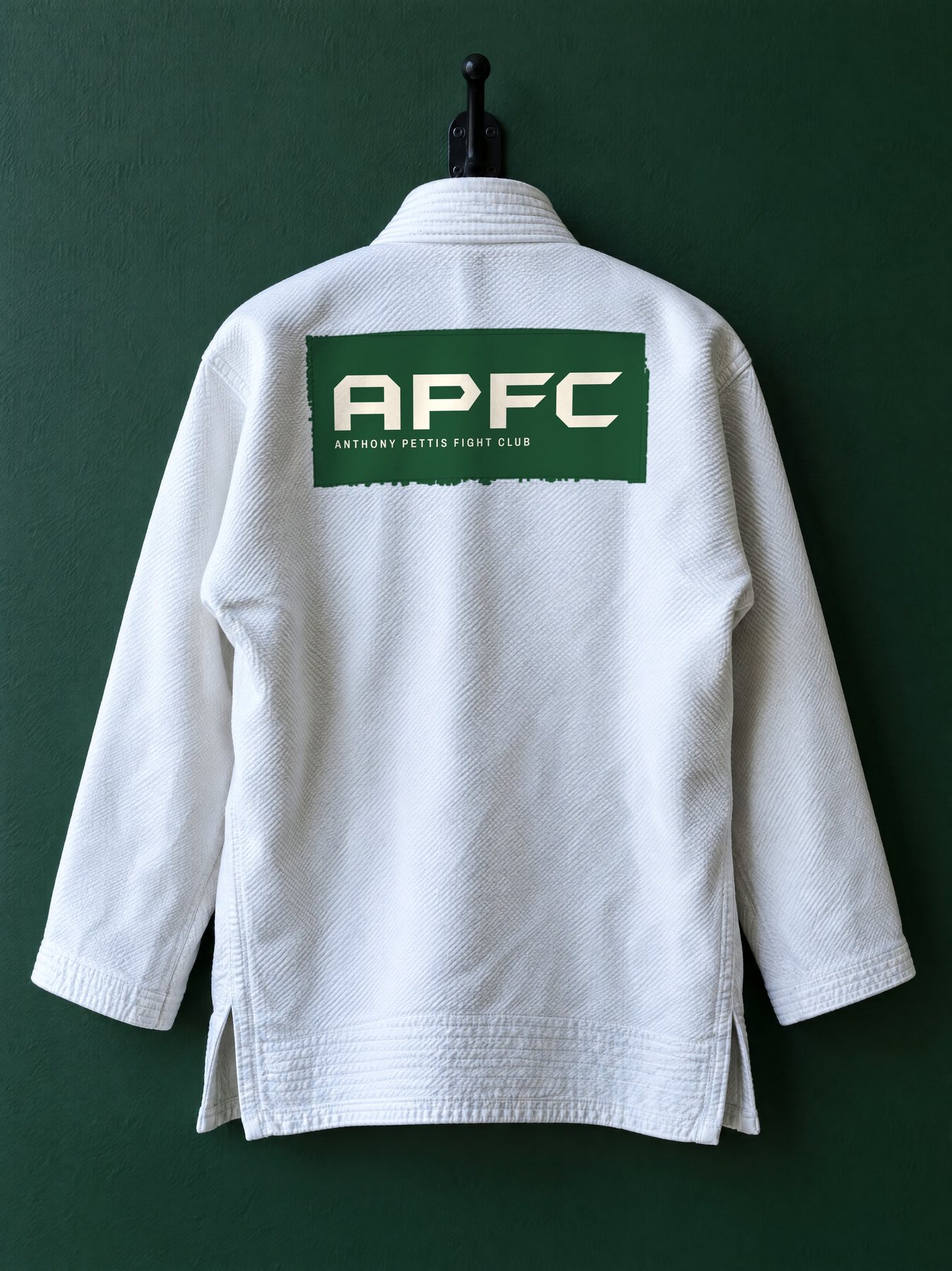
The gi

The disciplines

Brazilian jiu-jitsu

DRAFT 2026-11-04. Facts carry URLs. Level assignments, the ladder map, the class plan and the kids program are PROPOSALS for Anthony Pettis to rule.

Position before submission. Leverage over strength.

Brazilian jiu-jitsu is a grappling art. It was built in Brazil from the judo that Mitsuyo Maeda brought from Japan in 1914 (https://en.wikipedia.org/wiki/Mitsuyo_Maeda; https://www.graciemag.com/?p=406). A practitioner controls an opponent through a hierarchy of positions and ends the contest with a joint lock or a choke. The opponent concedes by tapping (IBJJF Rules Book art. 2.1, https://ibjjf.com/rules). The art is taught through cooperative drilling and live sparring without strikes. Its competition injury rate is measured in single digits per 1,000 match exposures (https://pmc.ncbi.nlm.nih.gov/articles/PMC4555620). It is the grappling base of modern mixed martial arts: Royce Gracie won UFC 1 with it in 1993 (https://www.ufc.com/event/ufc-1).

The disciplines

Where it comes from

  1. May 1882

    Jigoro Kano, having studied jujutsu, creates the method he named judo and opens a dojo he called the Kodokan (the Kodokan's own history page confirms 1882; the month comes from the IJF).

    ijf.org
  2. November 18, 1878

    Mitsuyo Maeda is born in Hirosaki, Aomori, Japan; he joins the Kodokan in 1895 and leaves Japan in 1904 to demonstrate judo abroad.

    en.wikipedia.org
  3. 1914

    Maeda arrives in Brazil; sources differ on the port and month (Gracie Magazine: July, in the northern state of Para; Wikipedia, citing a copy of his passport: November 1914 at Porto Alegre; Japan's National Diet Library: the port of Santos). He settles in Belem, Para, in 1915.

    graciemag.com
  4. December 20, 1915

    Maeda's first recorded demonstration in Belem.

    en.wikipedia.org
  5. 1917

    Carlos Gracie (1902 to 1994), then 14, sees Maeda in Belem and Maeda agrees to teach him.

    graciemag.com
  6. 1925

    Carlos Gracie opens the first Gracie academy in Rio de Janeiro (the traditional date, also given by Japan's National Diet Library). Gracie Barra places it at Rua Marques de Abrantes 106; Wikipedia's Carlos Gracie article dates the academy at that address to September 1930 under Donato Pires dos Reis, so the address and sequence are disputed.

    blog.graciebarra.com
  7. October 1, 1913

    Helio Gracie is born in Belem; he adapts Maeda's ground-focused judo so that a smaller, weaker practitioner can defend against and defeat a larger opponent.

    en.wikipedia.org
  8. November 28, 1941

    Maeda dies in Belem; the Kodokan had promoted him to 7th dan the day before.

    en.wikipedia.org
  9. October 23, 1951

    Helio Gracie fights Masahiko Kimura at the Maracana in Rio de Janeiro; Kimura wins by technical submission in the second round with gyaku-ude-garami, the shoulder lock BJJ now calls the kimura (Helio Gracie's Wikipedia article gives 22 October; the dedicated fight article and Gracie Magazine give 23 October).

    en.wikipedia.org
  10. May 1955

    Helio Gracie fights Valdemar Santana in Rio for almost four hours (the record lists 3 hours 42 minutes); Santana wins by TKO.

    en.wikipedia.org
  11. 1967

    The Guanabara Jiu-Jitsu Federation is created in Rio under the National Sports Confederation, with Helio Gracie as president.

    graciemag.com
  12. November 12, 1993

    UFC 1 at McNichols Arena, Denver: Royce Gracie wins the tournament, finishing Gerard Gordeau by submission at 1:44 of round 1; the event was co-created by Rorion Gracie and Art Davie.

    ufc.com
  13. 1994

    The International Brazilian Jiu-Jitsu Federation (IBJJF) is created; Gracie Magazine and Bleacher Report credit Carlos Gracie Jr. (Wikipedia's infobox lists formation as 2002; the sources differ.)

    graciemag.com
  14. 1996

    The first World Jiu-Jitsu Championship is held on 3 and 4 February 1996 at the Tijuca Tenis Clube in Rio de Janeiro; it has been held annually since.

    graciemag.com
  15. January 29, 2009

    Helio Gracie dies at 95 in Itaipava, Petropolis, Rio de Janeiro state.

    en.wikipedia.org
  16. August 7, 2018

    Anthony Pettis receives his BJJ black belt from Daniel Wanderley after submitting Michael Chiesa at UFC 226 (7 July 2018); the bjjee.com report of 9 August 2018 embeds Instagram posts dated 7 August 2018, and Wanderley Jiu-Jitsu in Milwaukee lists him among its black belts.

    bjjee.com
  17. June 2026

    IBJJF publishes the current General System of Graduation (v3.3), allowing black belt at 18 only for an athlete who won the Adult World title at brown belt.

    ibjjf.com

The disciplines

How it works

  1. Leverage over strength: Helio Gracie's adaptation of Maeda's judo was built so that smaller, weaker practitioners could defend themselves and defeat larger opponents (https://en.wikipedia.org/wiki/H%C3%A9lio_Gracie); Gracie Barra describes the art as using an attacker's energy against them rather than opposing it directly (https://blog.graciebarra.com/post/the-origins-of-jiu-jitsu-the-history-behind-the-art).
  2. Position before submission: the IBJJF rule book says matches should unfold as a progression of positions of technical control that ultimately result in a submission hold, and the scoring table encodes the hierarchy, takedown 2, sweep 2, knee on belly 2, guard pass 3, mount 4, back mount 4, back control 4 (Rules Book v6.1 arts. 3 and 4, https://ibjjf.com/rules).
  3. Control is measured in seconds: no position scores until it is stabilized for 3 seconds (art. 3.1, https://ibjjf.com/rules).
  4. The tap is the contract: a match ends on two hand taps on the opponent, the mat or oneself, two foot taps on the mat when the arms are trapped, a verbal withdrawal, or a scream or noise of pain while caught in a hold (art. 2.1); because everyone taps, the art can be trained at full resistance (https://ibjjf.com/rules).
  5. No strikes, ever: punches, elbows, knees, head butts, kicks, biting, hair pulling and pressure on the eyes or genitals are disciplinary fouls (art. 6.1, https://ibjjf.com/rules).
  6. Live sparring is the laboratory, and where most injuries happen: 77.6 percent of injuries in a survey of 1,140 athletes occurred during sparring (https://pmc.ncbi.nlm.nih.gov/articles/PMC8721390).
  7. Rank is earned under a professor and registered: IBJJF membership below black belt is signed by an affiliated black belt professor, and black belt promotions by a black belt with at least 2 certified degrees (Graduation System art. 6, https://ibjjf.com/graduation-system).
  8. Age-gated technique: all 26 listed illegal moves are banned for ages 4 to 12 and the banned set shrinks with age and belt (Rules Book v6.1 art. 6.2.3 table, https://ibjjf.com/rules).

The disciplines

The techniques, by level

30 of 30 techniques

Shrimp (hip escape)

Level 1 Foundation

Lying on the back, plant a foot, turn to a hip and push the hips away to create space under a top player.

At APFC
Solo in lines down the mat, then with a partner's hand on the chest as resistance; the first movement of week one.

Bridge (upa)

Level 1 Foundation

An explosive hip lift off the shoulders that unbalances a top player.

At APFC
Solo bridges, then bridge-and-roll with a cooperative mounted partner.

Breakfall (ukemi)

Level 1 Foundation

Slapping the mat with the arm and tucking the chin to spread impact when thrown or swept.

At APFC
Backward and side falls from kneeling, then from standing, before any takedown is drilled.

Technical stand-up

Level 1 Foundation

Standing from the ground with one hand and one foot posted so the hips face the opponent.

At APFC
Solo, then as the answer to getting up safely from guard.

Grappling stance and grip fighting

Level 2 Technique

A staggered, low stance with hands fighting for collar, sleeve or, in no-gi, wrist and collar ties.

At APFC
Partnered grip games with no takedowns, then with takedowns; the IBJJF penalizes pulling guard without a grip (art. 6.2.2 A), so grips come first.

Double-leg takedown

Level 2 Technique

A level change, a penetration step, both arms behind the knees and a drive that puts the opponent on the back (2 points when held 3 seconds, IBJJF art. 4.1).

At APFC
Shot drilled on a pad or cooperative partner; the finish drilled with the partner breakfalling.

Single-leg takedown

Level 3 Conditioning

Capturing one leg and running the opponent off balance; the head-outside single is listed as prohibited for ages 4 to 17 and adult white belts (IBJJF table row 11, not penalized).

At APFC
Head-inside single only, from the grip-fighting stance.

Osoto-gari (outer reap)

Level 2 Technique

A judo throw: step beside the opponent, reap the leg from behind while pulling the upper body back.

At APFC
Static fit-ins, then with a cooperative partner who breakfalls.

Guard pull

Level 3 Conditioning

Sitting to guard with grips established so the match goes to the ground; jumping to closed guard on a standing opponent is a foul for all under-15 divisions and all white belts (IBJJF art. 6.2.2 W).

At APFC
Taught as sit, never jump, with a collar-and-sleeve grip.

Closed guard

Level 1 Foundation

On the back with legs locked around the opponent's waist; the bottom player controls posture and attacks. The IBJJF defines guard as using one or more legs to block the opponent from reaching side control or north-south (art. 4.2 note 1).

At APFC
Posture breaking and the first sweep and submission from it.

Guard passing (knee slice, toreando)

Level 2 Technique

Getting past the legs to side control or north-south and holding for 3 seconds (3 points, IBJJF art. 4.2).

At APFC
Two passes only, drilled against an open guard offering light resistance.

Side control

Level 1 Foundation

Chest-to-chest control across the opponent's body after a pass; it scores through the pass, not on its own.

At APFC
Weight placement and the cross-face and underhook frame, held while the partner shrimps.

Knee on belly

Level 3 Conditioning

Knee or shin on the belly, chest or ribs with the other knee off the ground, held 3 seconds (2 points, IBJJF art. 4.3).

At APFC
Transition from side control with the partner flat; balance drills before pressure.

Mount

Level 1 Foundation

Sitting on the torso, clear of half guard, with two knees or a knee and a foot on the mat, held 3 seconds (4 points, IBJJF art. 4.4).

At APFC
Base and grapevine drills while the partner bridges.

Back control

Level 2 Technique

Heels between the opponent's thighs (hooks) without crossing the feet, held 3 seconds (4 points, IBJJF art. 4.5).

At APFC
Seatbelt grip and hooks from a turtle partner, then holding against light escapes.

Half guard (bottom)

Level 3 Conditioning

Lying on the back or side with one of the top player's legs trapped (IBJJF art. 4.2 note 2).

At APFC
Knee shield and underhook; the first recovery to full guard and the first half-guard sweep.

Sweeps (scissor sweep, hip bump)

Level 2 Technique

Reversals from guard that put the bottom player on top, held 3 seconds (2 points, IBJJF art. 4.6).

At APFC
Scissor sweep from closed guard with a partner who posts and falls.

Rear naked choke

Level 2 Technique

From back control, one arm under the chin, the other hand behind the head, squeeze with the chest; not on the IBJJF illegal-moves table, so legal in all age groups (chokes with spinal lock are banned under 16).

At APFC
From a cooperative partner's back; squeeze slowly and release on the tap from day one.

Cross collar choke (gi)

Level 2 Technique

Both hands in the collars, elbows drop, forearms close the carotids.

At APFC
From mount and closed guard, the first grip taught before the second.

Straight armbar

Level 2 Technique

Hips under the elbow, leg across the face, hips lift against the straight arm; legal in all IBJJF age groups. Armbars caused 10 of 14 competition elbow injuries in Scoggin et al. 2014 (https://pmc.ncbi.nlm.nih.gov/articles/PMC4555620).

At APFC
From mount first, then closed guard; the partner taps early and the attacker extends slowly.

Kimura

Level 3 Conditioning

A figure-four shoulder lock named after Masahiko Kimura's 1951 win over Helio Gracie.

At APFC
From side control and from guard, finishing slowly behind the back.

Triangle choke

Level 3 Conditioning

Legs figure-four around the neck and one arm; the triangle pulling the head is banned for ages 4 to 15 (IBJJF row 7).

At APFC
From closed guard with the head-down, angle-out sequence; kids drill the lock without pulling the head.

Guillotine

Level 3 Conditioning

A front headlock choke under the chin; the frontal guillotine is banned for ages 4 to 15 (IBJJF row 5).

At APFC
Taught to adults and 16-plus from a sprawl, with the arm-in variant delayed.

Straight ankle lock

Level 4 Competitor

A straight foot lock on the Achilles tendon; banned for ages 4 to 15 (row 3), legal from 16 and for adult white belts; turning toward the foot not under attack is banned below brown belt (row 16).

At APFC
Introduced only after the student can fall and escape safely; positions before pressure.

Kneebar, toe hold, heel hook

Level 5 Fighter

Leg locks on the knee, ankle and heel; kneebar and toe hold banned below adult brown belt (rows 14 and 15); heel hook and knee reaping banned in gi for everyone and in no-gi below brown belt (rows 17 and 19).

At APFC
Not taught to beginners; brown-belt and no-gi curriculum.

Tapping early

Level 1 Foundation

Conceding before injury: two hand taps on the opponent, mat or self, two foot taps on the mat when the arms are trapped, a verbal withdrawal, or a scream or noise of pain while caught in a hold (IBJJF art. 2.1).

At APFC
The first rule of the first class; the instructor demonstrates the tap before any submission.

Mount escape (elbow escape, bridge-and-roll)

Level 2 Technique

Combining the shrimp and the bridge to recover guard or reverse.

At APFC
Partner holds mount at 50 percent; the student drills both escapes in sequence.

Posture and hand fighting in guard

Level 2 Technique

Keeping the head up and elbows in so the bottom player cannot break posture or attack the arms.

At APFC
Head up, hips back, with a partner pulling the collar.

Choke defense (chin tuck, hand fighting)

Level 2 Technique

Protecting the neck with the chin and both hands, then turning into the attacker.

At APFC
Against a cooperative rear naked choke, before any live back attacks.

Guard retention

Level 3 Conditioning

Using frames and hip movement to keep the legs between oneself and the passer.

At APFC
Solo leg drills, then survive-the-pass rounds starting from open guard.

The disciplines

The rules

amateur

IBJJF Rules Book v6.1 (June 2024). Single-elimination brackets; gold, silver and two bronzes. Athletes register through an IBJJF-approved academy and compete only at their registered belt; judo black belts, college-level wrestlers and anyone who has fought MMA (pro or amateur) may not enter as white belts. Divisions by age (current year minus birth year), belt, weight and sex. Match times: Mighty Mite I to III (ages 4 to 6) 2 min; Pee Wee I to III (7 to 9) 3 min; Junior I to III (10 to 12) 4 min; Teen I to III (13 to 15) 4 min; Juvenile I and II (16 to 17) 5 min; Adult (18 and over) white 5, blue 6, purple 7, brown 8, black 10 min; Master 1 (30 and over) 5 to 6 min; Masters 2 to 7 5 min. A match is decided by submission, stoppage, disqualification, loss of consciousness, score, referee decision or random pick. Illegal-moves table by age and belt (26 rows): ages 4 to 12 all 26 banned (spinal-lock chokes, straight foot locks, Ezekiel, guillotine, omoplata, triangle pulling the head, arm triangle, kidney or rib compression, wrist locks, every leg lock, slams, spinal locks, scissor takedowns, finger bending, belt throws and suplexes onto the head or neck); 13 to 15 rows 2 to 26; 16 to 17 and adult white belts rows 9 to 26; adult blue and purple rows 12 to 26; adult brown and black gi rows 17 to 26; adult brown and black no-gi rows 21 to 26. Jumping to closed guard is a foul for all under-15 divisions and all white belts. Strikes of any kind are disciplinary fouls. Amateur MMA context: the ABC Unified Rules of MMA (https://www.abcboxing.com/unified-rules/) govern the cage, and amateur MMA contestants must be at least 18 in Wisconsin (SPS 192.06(2)(a), https://docs.legis.wisconsin.gov/document/administrativecode/SPS%20192.06) and Illinois (68 Ill. Adm. Code 1370.710(c), https://www.law.cornell.edu/regulations/illinois/Ill-Admin-Code-tit-68-SS-1370.710); there are no youth cage bouts.

equipment

Gi of cotton or cotton-like woven fabric, entirely white, royal blue or black, matching top and pants; sleeves no more than 2 cm from the wrist, pants no more than 2 cm above the ankle bone; belt 4 to 5 cm wide in the rank color, wrapped twice, double knotted, ends 20 to 30 cm. No-gi: skin-tight rash guard in black, white or black and white with at least 10 percent rank color (or 100 percent rank color), board or compression shorts to mid-thigh and no longer than the knee, no pockets, zippers, buttons or metal. Forbidden: any foot gear, headgear, hair pins, jewelry, cups, any hard-material protector and eye protectors; bulky joint braces that hinder gripping; brief-type undergarments mandatory; nails trimmed, long hair tied, no creams or oils (art. 8; https://ibjjf.com/uniform).

scoring

Points require 3 seconds of stabilization: takedown 2, sweep 2, knee on belly 2, guard pass 3, mount 4, back mount 4, back control 4; points accumulate through a sequence (a pass straight into mount scores 7). Advantages for near-completed positions and submission attempts that put the opponent in real danger. Ties are broken by advantages, then fewest penalties, then referee decision. Penalties: disciplinary (profanity, hostility, strikes, biting, hair pulling, eye or groin pressure, fake combat) and technical (lack of combativeness, serious fouls such as pulling guard without a grip or fleeing the mat, severe fouls including illegal holds).

APFC's own rule

There are no youth cage bouts. Wisconsin licenses professional and amateur MMA contestants only at 18 or older (SPS 192.06(2)(a), https://docs.legis.wisconsin.gov/document/administrativecode/SPS%20192.06). Illinois registers amateur MMA contestants only at 18 or older (68 Ill. Adm. Code 1370.710(c), https://www.ilga.gov/commission/jcar/admincode/068/068013700F07100R.html; https://www.law.cornell.edu/regulations/illinois/Ill-Admin-Code-tit-68-SS-1370.710). Members under 18 train and grade in every discipline and compete in the component arts under their own governing bodies.

The disciplines

Ranks and belts

IBJJF General System of Graduation, June 2026, v3.3. Ages 4 to 15 (13 belts): white; grey-white, grey, grey-black (4 to 15); yellow-white, yellow, yellow-black (7 to 15); orange-white, orange, orange-black (10 to 15); green-white, green, green-black (13 to 15); no minimum time; monthly, quarterly or four-month stripe systems suggested. Age 16 and over: white, blue (16 and over), purple (16 and over), brown (18 and over), black (19 and over, or 18 for an Adult World Champion at brown), red-black 7th degree (49 and over), red-white 8th degree (56 and over), red 9th and 10th degree (66 and over; the 10th was given only to Carlos, Oswaldo, George, Gastao and Helio Gracie). Adult minimum times: blue 2 years (1 year for a former grey, yellow or orange belt; none for a former green belt or juvenile blue belt), purple 1.5 years, brown 1 year, black 31 years before red-black (fixed), red-black 7, red-white 10. At 16, grey, yellow and orange belts become blue; green may become blue or purple at the professor's decision. Up to 4 stripes on white through brown; 6 degrees on black (1st after 3 years of proven activity). Black belt certification needs IBJJF affiliation, a First Aid or CPR certificate and an IBJJF rules course within 12 months; membership below black is signed by an affiliated black belt professor and black belt promotions by a black belt with at least 2 degrees.

PROPOSAL for Anthony Pettis to rule; not a governing-body standard

  1. Level 1 Foundation

    Adult white belt with no stripes; kids white and grey-white; movement, breakfalls, the tap, closed guard, mount, side control, escapes.

  2. Level 2 Technique

    Adult white belt with stripes through new blue belt; kids grey, grey-black and the yellow group; passes, sweeps, back control, the first four submissions, defense.

  3. Level 3 Conditioning

    Adult blue belt; kids orange group (10 to 15); half guard, knee on belly, guillotine and triangle for 16-plus, positional sparring with conditioning targets.

  4. Level 4 Competitor

    Adult blue and purple belts registered with the IBJJF and competing; kids green group (13 to 15) and juveniles (16 to 17) under Teen and Juvenile rules; strategy under the point system, straight ankle locks for 16-plus, weight management.

  5. Level 5 Fighter

    Purple belt and above, age 18 and over, carrying BJJ into MMA or the no-gi brown-belt curriculum (kneebar, toe hold, heel hook in no-gi); under-18s cannot be at Level 5 in the MMA sense because amateur MMA bouts are 18 and over in Wisconsin and Illinois.

The disciplines

A class at APFC

PROPOSAL: a class plan for Anthony Pettis to rule; the round lengths and rules cited inside it are sourced

10 min

Warm-up and movement (PROPOSAL)

Line-up, bow in, jogging, shrimps, bridges, breakfalls, technical stand-ups, animal walks for kids.

20 min

Technique of the day (PROPOSAL)

Two linked techniques from one position, demonstrated in three steps, drilled 5 to 10 repetitions a side with a cooperative partner.

12 min

Positional sparring (PROPOSAL)

Rounds of 2 to 3 minutes starting in the day's position, reset on a lost position or a submission; adults at full resistance, kids at controlled resistance with only the techniques legal for their IBJJF age group.

13 min

Live rolling for adults, games for kids (PROPOSAL)

Adults: two 5-minute rounds from the knees or feet. Kids 6 to 12: takedown and escape games with no submissions beyond those legal for 4 to 12. Kids 3 to 6: no live rolling.

5 min

Cool-down and close (PROPOSAL)

Stretch, questions, line-up, stripes awarded when due, bow out.

The disciplines

For kids

Framework

IBJJF divisions and belts begin at age 4 (Mighty Mite I), so ages 3 to 5 are a club extension (PROPOSAL).

Ages 3 to 6

the CDC says preschoolers 3 to 5 should be active throughout the day (https://www.cdc.gov/physical-activity-basics/guidelines/children.html); proposed content is breakfalls, shrimping, bridging, animal walks, holding mount and side control on a cooperative partner and escaping to the feet, with no submissions, no live rolling, no competition and 30-minute classes.

Ages 6 to 12 (Mighty Mite III, Pee Wee, Junior)

match times 2, 3 and 4 minutes by age; every one of the 26 listed illegal moves is banned for ages 4 to 12, so no chokes with spinal lock, guillotines, Ezekiel chokes, arm triangles, omoplatas, triangles pulling the head, wrist locks, leg locks or slams; the straight armbar and rear naked choke are not on the table; jumping to closed guard is a foul in every under-15 division (https://ibjjf.com/rules); belts are the grey group (4 to 15), yellow group (7 to 15) and orange group (10 to 15) with no minimum time (https://ibjjf.com/graduation-system); competitors 15 and under had 4.1 injuries per 1,000 exposures against 10.8 for 16 and over (https://pmc.ncbi.nlm.nih.gov/articles/PMC4555620).

Ages 13 to 17

Teen I to III (13 to 15) have 4-minute matches and rows 2 to 26 of the illegal table still apply, with green group belts from 13; Juvenile I and II (16 to 17) have 5-minute matches and the adult white belt technique set (rows 9 to 26 illegal), so straight foot locks, guillotines, Ezekiel chokes, arm triangles and omoplatas become legal, and blue and purple belts are available from 16 (https://ibjjf.com/rules; https://ibjjf.com/graduation-system).

No cage bouts for anyone under 18

amateur MMA contestants must be at least 18 in Wisconsin (SPS 192.06(2)(a), https://docs.legis.wisconsin.gov/document/administrativecode/SPS%20192.06) and Illinois (68 Ill. Adm. Code 1370.710(c), https://www.law.cornell.edu/regulations/illinois/Ill-Admin-Code-tit-68-SS-1370.710); a 13 to 17 year old trains BJJ and competes in IBJJF grappling only.

Safety rules for children

no head contact of any kind because BJJ has no striking (punches, elbows, knees, head butts and kicks are disciplinary fouls at every age, IBJJF art. 6.1); the IBJJF forbids headgear and any hard-material protector in competition (art. 8.3.3), and no governing-body rule requires or forbids soft ear guards in class; an athlete who loses consciousness from head trauma may not compete again in the same tournament (art. 2.4 note); no slams at any age; the American Academy of Pediatrics notes that noncontact basic forms carry lower injury risk, contact sparring and bouts higher risk, and that blows to the head and choking or submission movements can cause concussions or significant head injuries (https://pubmed.ncbi.nlm.nih.gov/27940732/); PROPOSAL: a certified instructor on the mat for every live round, submissions applied slowly and released on the tap, and parents in sight of the kids mat.

The disciplines

Safety, honestly

In 2,511 matches (5,022 exposures) at eight Hawaii tournaments from 2005 to 2011 the injury rate was 9.2 per 1,000 exposures; 78.3 percent were orthopedic; the elbow was the most injured joint (14 of 36 orthopedic injuries) and armbars caused 10 of those 14; reported comparison rates were MMA 236 to 286, judo 25.3 to 130.6, taekwondo 20.5 to 139.5 and wrestling 9.0 to 30.7 per 1,000 exposures.

pmc.ncbi.nlm.nih.gov

Competitors 15 and under had 4.1 injuries per 1,000 exposures; competitors 16 and over had 10.8 per 1,000.

pmc.ncbi.nlm.nih.gov

In an online survey of 1,140 athletes from 62 countries, 1,052 injuries with at least 2 weeks of time loss were recorded in 784 athletes over 3 years (308 per 1,000 athletes per year); lower extremity 45.7 percent, upper extremity 30.2 percent, knee 27.1 percent; 77.6 percent happened in sparring; submissions caused 29.7 percent and takedowns 26.4 percent; regular competition, older age and higher belt were risk factors.

pmc.ncbi.nlm.nih.gov

At one Ontario club (70 respondents), 91 percent had been injured in training and 60 percent of competitors in competition; two-thirds of the injured needed medical attention and 15 percent needed surgery; injuries were mainly sprains and strains of the fingers, upper extremity and neck.

pmc.ncbi.nlm.nih.gov

US emergency department data (NEISS 2014 to 2023, about 36,635 weighted visits for martial-arts head and spine injuries): jiu-jitsu accounted for 26.9 percent; lumbar strains 19.8 percent, cervical strains 18.3 percent and concussions 18.4 percent of narratives.

pubmed.ncbi.nlm.nih.gov

The American Academy of Pediatrics: noncontact basic forms carry a lower relative injury risk; contact sparring, competitive training and bouts carry a higher risk; blows to the head and choking or submission movements can cause concussions or significant head injuries.

pubmed.ncbi.nlm.nih.gov

IBJJF competition bans strikes, slams, spinal locks without a choke and neck-landing suplexes at every age and belt, and heel hooks and knee reaping below brown belt; headgear and hard protectors are forbidden; an athlete knocked unconscious by head trauma is out for the tournament.

ibjjf.com

The disciplines

What it gives you

A systematic review of 58 studies (1,496 participants) found BJJ athletes have low body fat and a predominantly mesomorphic somatotype, VO2max of roughly 42 to 52 mL/kg/min in male athletes, and that strength and power may relate to competitive success.

pmc.ncbi.nlm.nih.gov

Male US service members and veterans with PTSD symptoms who completed a 5-month, 40-session BJJ program showed clinically meaningful improvement in PTSD symptoms and decreases in depression, anxiety and alcohol use, with effect sizes of 0.80 to 1.85 (single-group pilot; 9 of 23 enrolled completed).

pmc.ncbi.nlm.nih.gov

Among 420 BJJ athletes, black belts scored higher than white belts on mental strength, resilience, self-efficacy, self-control and life satisfaction and reported fewer mental health disorders, with small effects (cross-sectional association, not proof of cause).

pmc.ncbi.nlm.nih.gov

In 367 participants (277 martial arts and combat sports athletes, including BJJ, and 90 non-athletes), long-term training was linked to lower aggression (cross-sectional).

pmc.ncbi.nlm.nih.gov

A meta-analysis of 12 studies (507 participants aged 6 to 18) found martial arts training reduced aggression and other externalizing behavior in youth, with a medium effect size of 0.65 in the nine intervention and longitudinal studies.

doi.org

Martial arts can provide vigorous physical exercise that improves overall fitness.

pubmed.ncbi.nlm.nih.gov

Children and adolescents 6 to 17 need at least 60 minutes a day of moderate-to-vigorous activity with muscle-strengthening and bone-strengthening activity at least 3 days a week; a grappling class supplies all three.

cdc.gov

The disciplines

Anthony and this art

Anthony Pettis holds a Brazilian jiu-jitsu black belt. He received it from Daniel Wanderley in August 2018, a month after submitting Michael Chiesa at UFC 226 on July 7, 2018 (https://www.bjjee.com/articles/ufcs-anthony-pettis-received-black-belt-jiu-jitsu/, a report of August 9, 2018 that embeds Instagram posts dated August 7, 2018; https://www.ufc.com/event/ufc-226). Wanderley Jiu-Jitsu in Milwaukee lists Anthony and Sergio Pettis among its black belts (https://wanderleyjiujitsu.com/about). He won the UFC lightweight title by first-round armbar at UFC 164 in Milwaukee on August 31, 2013 (https://www.ufc.com/event/ufc-164). The UFC lists him as a third-degree black belt in taekwondo and a former WEC and UFC lightweight champion (https://www.ufc.com/athlete/anthony-pettis).

The disciplines

The glossary

20 of 20 terms

Gi
The cotton jacket, pants and belt; the IBJJF allows white, royal blue or black.
No-gi
Grappling in a rash guard and shorts with no cloth to grip; the IBJJF runs separate no-gi attire and technique rules.
Roll
A live sparring round.
Tap
The signal of submission: two hand taps on the opponent, mat or self, two foot taps on the mat when the arms are trapped, a verbal withdrawal, or a scream of pain while caught in a hold (IBJJF art. 2.1).
Guard
Using one or more legs to stop the opponent reaching side control or north-south (IBJJF art. 4.2 note 1).
Closed guard
Guard with the legs locked around the opponent's waist.
Half guard
Guard with one of the top player's legs trapped (IBJJF art. 4.2 note 2).
Pass
Getting past the legs into side control or north-south for 3 seconds; 3 points.
Sweep
Reversing from bottom guard to top for 3 seconds; 2 points.
Takedown
Taking a standing opponent to the ground and holding top for 3 seconds; 2 points.
Mount
Sitting on the torso clear of half guard; 4 points.
Side control
Chest-to-chest control across the body; scores through the pass, not on its own.
Knee on belly
Knee or shin on the torso with the other knee up; 2 points.
Back control and hooks
Heels between the opponent's thighs from behind; 4 points.
Submission
A joint lock or choke that forces the tap.
Armbar
Hyperextending the elbow with the hips; the most common competition injury mechanism in the Scoggin study.
Kimura
A figure-four shoulder lock named for Masahiko Kimura's 1951 win over Helio Gracie.
Advantage
A near-score or a dangerous submission attempt; the first tiebreaker under IBJJF rules.
Stripes and degrees
Marks on the belt: up to 4 on white through brown, 6 on black.
Professor
A black belt instructor; IBJJF membership and promotions are signed by one.
The disciplines

Frequently asked questions

The disciplines

Sources

56 sources

Book a free class

Book a free class