APFC 27 · Milwaukee · December 13 · Landmark Credit Union LiveTickets and the card
West Allis

The disciplines

Kickboxing

DRAFT 2026-11-04. Facts carry URLs. Level assignments, the ladder map, the class plan and the kids program are PROPOSALS for Anthony Pettis to rule.

Hands and feet, taught as equals.

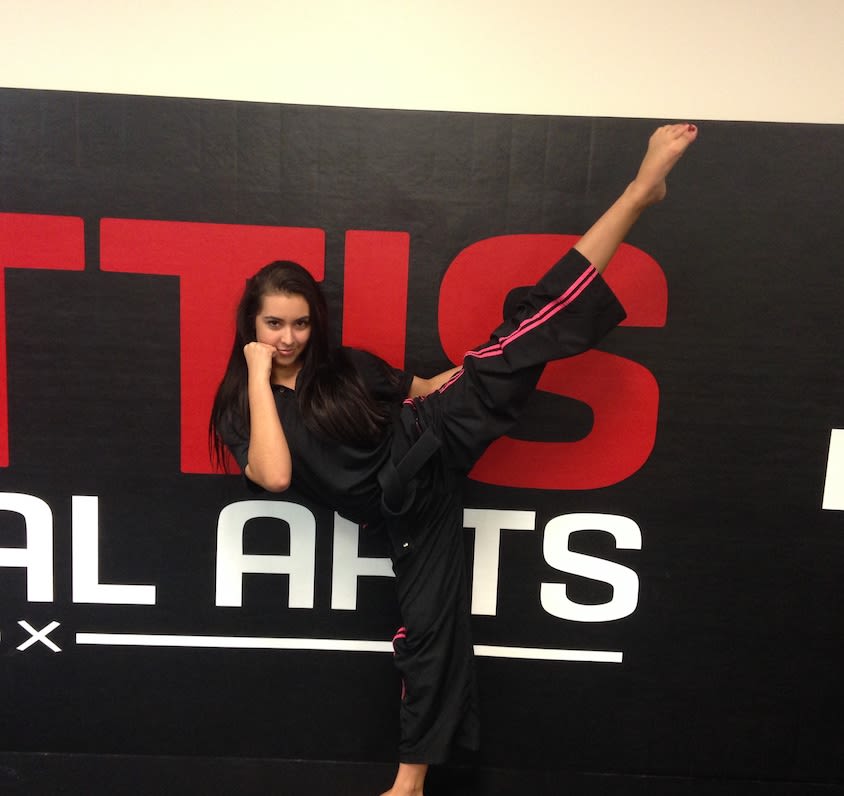
Kickboxing is stand-up striking with hands and feet. It joins boxing's punches to the kicks of karate and Muay Thai. WAKO, its IOC-recognized world body, defines it as a "modern contact fighting sport" built from defined disciplines, from controlled tatami point fighting to full-power ring fighting with low kicks and knees (WAKO rulebook, Chapter 1 Article 1, https://www.kickboxing.fi/wp-content/uploads/2025/03/WAKO-kickboxing-rules.pdf). For a gym it is the discipline that teaches range, rhythm and the use of all four limbs. It is the striking language Anthony Pettis trained in at Roufusport under Duke Roufus, a multi-time kickboxing world champion (https://en.wikipedia.org/wiki/Duke_Roufus; https://en.wikipedia.org/wiki/Anthony_Pettis).

The disciplines

Where it comes from

  1. November 1959

    Tatsuo Yamada publishes his plan for a new art tentatively called karate-boxing, a karate and Muay Thai hybrid.

    en.wikipedia.org
  2. February 12, 1963

    Japanese karate fighters from the Oyama dojo beat a Muay Thai team 2 to 1 at Lumpinee Stadium, Bangkok (the 2 to 1 result is uncited on the reference page).

    en.wikipedia.org
  3. 1960s

    Promoter Osamu Noguchi (1934 to 2016) coins the Japanese term kickboxing for the Muay Thai and karate hybrid.

    en.wikipedia.org
  4. 1966

    Noguchi founds the Kickboxing Association, the first kickboxing sanctioning body; the first kickboxing event is held in Osaka on April 11, 1966 (both entries uncited on the reference page; treat the exact dates as unconfirmed).

    en.wikipedia.org
  5. January 17, 1970

    Joe Lewis knocks out Greg Baines in the second round in the first recognized American full-contact kickboxing bout; boxing gloves are used and the word kickboxing is used.

    en.wikipedia.org
  6. September 1974

    The Professional Karate Association holds the first World Championship in Full Contact at the Los Angeles Sports Arena, promoted by Mike Anderson (WAKO's history credits Joe Lewis and Mike Anderson as organizers; Wikipedia's PKA entry credits Don and Judy Quine with Anderson); Joe Lewis, Jeff Smith, Bill Wallace and Isaias Duenas are the first champions.

    wako.sport
  7. 1976

    The World Kickboxing Association (WKA) is formed in the United States; in the Netherlands Jan Plas and Thom Harinck found the NKBB, the Dutch kickboxing association.

    en.wikipedia.org
  8. February 26, 1977

    WAKO is officially founded in Berlin by Georg Brueckner; WAKO dates the start of its European activity to 1976.

    wako.sport
  9. 1978

    The first WAKO World Championships in semi- and full-contact are held with 110 competitors from 18 countries; Jan Plas opens Mejiro Gym in Amsterdam after learning kickboxing from Kenji Kurosaki, the root of Dutch style.

    wako.sport
  10. 1992

    The International Kickboxing Federation (IKF) is founded in the United States by Steve Fossum and Dan Stell, headquartered in Newcastle, California.

    en.wikipedia.org
  11. 1993

    Kazuyoshi Ishii founds K-1; its first event, K-1 Sanctuary I, is held March 30, 1993 at Korakuen Hall, and the first K-1 Grand Prix is held April 30, 1993 at the Yoyogi National Gymnasium, Tokyo, where Branko Cikatic knocks out Ernesto Hoost in the final. K-1 rules (punches, kicks, knees, no elbows, limited clinch) become the template for modern ring kickboxing.

    en.wikipedia.org
  12. 1995 to 1998

    Milwaukee's Duke Roufus wins multiple super heavyweight kickboxing world titles; Wikipedia lists WKA, ISKA and WAKO (1995), WKBA (1996), KICK (1997) and IKF (1998), of which only the December 4, 1998 IKF title carries a citation, and Roufusport describes him as a four-time kickboxing world champion.

    en.wikipedia.org
  13. May 26, 2012

    Glory, founded in 2012, holds Glory 1 at the Ericsson Globe in Stockholm.

    en.wikipedia.org
  14. 2014

    WAKO becomes a member federation of the International World Games Association.

    theworldgames.org
  15. 2017

    Kickboxing (K1 Style) appears at The World Games in Wroclaw as an invitational sport.

    theworldgames.org
  16. November 30, 2018

    The IOC Executive Board, meeting in Tokyo, grants WAKO provisional recognition.

    olympics.ie
  17. July 20, 2021

    The 138th IOC Session in Tokyo grants WAKO full recognition; WAKO reports 130 member countries, 106 recognized by their sports ministries or Olympic committees.

    wako.sport
  18. 2022 and 2025

    Kickboxing is on the official program of The World Games in Birmingham (K1 Style) and Chengdu (K1 Style and Point Fighting), and is listed for Karlsruhe 2029.

    theworldgames.org
  19. October 17, 2025

    Roufusport announces that Duke Roufus, founder of Roufusport and Anthony Pettis's coach, has died in his sleep at 55; Wikipedia and Fox give October 17 as the date of death, while CBS Sports quotes partner Scott Joffe saying he died on Thursday, October 16.

    en.wikipedia.org
The disciplines

How it works

  1. Hands and feet as equals: WAKO's rule for every discipline is that hand and foot techniques should be used equally during the entire fighting period; a fighter who only boxes or only kicks is penalized in the scoring (WAKO rulebook Chapter 3 Article 4, Chapter 5 Article 4, Chapter 8 Article 4, https://www.kickboxing.fi/wp-content/uploads/2025/03/WAKO-kickboxing-rules.pdf).
  2. A ladder of contact: the sport is built as a progression from tatami disciplines (point fighting, light contact, kick light) fought with controlled contact and won on points, to ring disciplines (full contact, low kick, K1 Style) fought at full power and won by stoppage or points; kick light is defined as an intermediate stage between light contact and low kick (WAKO rulebook Chapter 1 Article 1, Chapter 5 Article 1). A club can teach the sport in the same order.
  3. Range decides the weapon: kicks are the long weapon, punches the middle, knees the short one; K1 Style allows the knee to legs, body or head with one knee per neck hold and a clinch that is active for 5 seconds only (WAKO rulebook Chapter 10 Articles 4.1 and 4.3). Teaching distance is teaching the sport.
  4. The low kick changes everything: full contact bans kicks below the waist, while low kick and K1 allow kicks to the thigh from outside, inside and the back (WAKO rulebook Chapter 9 Article 3); once the legs are a target, stance, weight and the shin check become the first lesson, the Dutch and Japanese contribution to the art (https://en.wikipedia.org/wiki/Jan_Plas).
  5. Clean technique scores, not effort: ring judges score a punch, kick or knee delivered from the right distance with full power to a legal target, judged on good form with balance, full power and speed, focus on the target, and timing and distance, and a blocked, partially deviated or stopped technique is not scored (WAKO rulebook Chapter 7 Article 8); in the tatami disciplines any technique that simply touches, brushes or pushes is not scored (Chapter 3 Article 6, Chapter 4 Article 6).
  6. Rounds are the unit of fitness: ring bouts are 3 rounds by 2 minutes with a one-minute break (WAKO Chapter 7 Article 4) and ABC amateur kickboxing scores 10-point-must rounds (https://www.abcboxing.com/unified-rules-of-amateur-kickboxing/); conditioning is written in rounds.
  7. Elite kickboxers are built: a review of the sport's physiology describes male kickboxers as mesomorphic and lean with high anaerobic power, with an activity-to-rest ratio of about 1:1 in elite fighters versus 1:2 to 1:5 in amateurs, the gap a conditioning program closes (https://europepmc.org/article/MED/28566813).
  8. Defense is the first skill tested: the Finnish federation's WAKO-aligned syllabus puts parrying, the front-leg shin block and moving on the ball of the foot in the first belt (https://www.kickboxing.fi/wp-content/uploads/2025/07/Vyokoesaannot-2025-06-08-EN.pdf).

The disciplines

The techniques, by level

24 of 24 techniques

Fighting stance (orthodox and southpaw)

Level 1 Foundation

Guard position with hands up protecting the face, elbows close, weight on the balls of the feet (WAKO grading program Front Guard and Side Guard, https://wako.sport/_files/ugd/6445bf_cae3b433b30e4526b97928d02379485f.pdf).

At APFC
Both-sided from day one; the Finnish first belt requires both stances, orthodox and southpaw (https://www.kickboxing.fi/wp-content/uploads/2025/07/Vyokoesaannot-2025-06-08-EN.pdf). Mirror work, then holding the stance while a partner pushes the guard.

Stepping footwork

Level 1 Foundation

Forward, backward and lateral steps that keep guard and balance: step forward with the front leg, maintaining guard, step backward with the rear leg (WAKO grading program).

At APFC
Lines across the mat, then stepping with a jab or cross on each step (the WAKO grade-one advancing step with technique execution).

Pivot and angle step

Level 2 Technique

Turning on the lead foot to leave the line of attack and create a new angle (coaching practice; footwork is required in both stances at every Finnish grade).

At APFC
After the straight steps: pivot drills off the jab, then pivot to escape a partner's walk-forward.

Guard and cover

Level 1 Foundation

Raising the hands to guard the head or tucking the forearms to guard the body, the cover-up (https://en.wikipedia.org/wiki/Kickboxing).

At APFC
Light partner taps on the gloves teach keeping the guard up under movement; checked at every grade.

Jab

Level 1 Foundation

Quick, straight punch from the lead hand (WAKO grading program).

At APFC
Stationary, then with a forward step; the Finnish first belt asks for two and three straight punches in sequence.

Cross

Level 1 Foundation

Powerful, straight punch from the rear hand (WAKO grading program).

At APFC
After the jab, with hip rotation on a pad; the one-two is the first combination.

Hook

Level 2 Technique

Circular punch aimed at the opponent's side (WAKO grading program); thrown to head or body.

At APFC
Second grade (the Finnish orange belt adds hooks to body and head); taught on pads with a short arc and a planted lead foot.

Uppercut

Level 2 Technique

Upward punch targeting the chin (WAKO grading program).

At APFC
Second grade; taught from a slight crouch into a rising line, then inside combinations.

Front kick (push kick, teep)

Level 1 Foundation

Push kick with the ball of the foot to the body (WAKO grading program); legal to torso and head, not the thigh, in K1 and low kick (WAKO rulebook Chapters 9 and 10).

At APFC
First kick taught: chamber the knee, extend, recoil; waist height with both legs (Finnish first belt).

Roundhouse kick

Level 1 Foundation

A chopping strike with the shin or instep to the body or head; K1 Style states it is allowed to attack using the shin (WAKO rulebook Chapter 10 Article 4.2).

At APFC
Waist height with both legs in the first grade; shield pads, then the combination jab, cross, roundhouse.

Low kick

Level 1 Foundation

Roundhouse to the thigh below the waist and above the knee from outside, inside and the back (WAKO low kick rules, Chapter 9 Article 3).

At APFC
The rear-leg low kick is in the Finnish first belt; taught with a step-out angle and the shin, never the foot, on a thigh pad.

Side kick

Level 2 Technique

A strike with the heel, with the leg held parallel to the ground (https://en.wikipedia.org/wiki/Kickboxing); legal to torso and head in every WAKO discipline.

At APFC
Second grade (Finnish orange belt); chamber across the body, drive the heel, recoil.

Spinning back kick

Level 3 Conditioning

A rear-leg kick delivered with the heel after a turn; legal to torso and head, not the thigh, in low kick and K1 (WAKO rulebook Chapters 9 and 10).

At APFC
After the side kick: look over the shoulder, chamber, strike with the heel; the Finnish orange belt lists the back kick.

Axe kick

Level 3 Conditioning

A downward stomping strike with the heel (https://en.wikipedia.org/wiki/Kickboxing); WAKO tatami rules allow the sole of the foot only.

At APFC
Flexibility work first; a high-level tatami weapon taught slow on a hanging pad.

Hook kick

Level 3 Conditioning

The leg swings out to the side and hooks back to strike the head with the heel or sole (Wikipedia); WAKO permits the sole only in tatami and lists the heel kick in ring disciplines.

At APFC
Slow on a hanging pad after the side kick; a point-fighting scoring kick.

Knee strike

Level 3 Conditioning

A long-range thrust into the stomach (straight knee, Wikipedia); in K1 Style the knee can be used to attack legs, body or head, one knee per neck hold (WAKO rulebook Chapter 10 Article 4.3).

At APFC
On a belly pad with hip drive; only for K1-rules students, never in children's classes.

Spinning back fist

Level 4 Competitor

A back-of-the-knuckle strike delivered with a turn; legal in K1 Style, illegal in WAKO full contact, low kick and point fighting (WAKO rulebook Chapters 3, 8, 9, 10).

At APFC
Taught late and only to K1-rules students, because it is a blind technique that needs control.

Foot sweep

Level 3 Conditioning

Foot sweeps at ankle level only, from outside to inside and vice versa, to unbalance the opponent and follow up (WAKO K1 rules Article 4.4); boot-to-boot in tatami disciplines.

At APFC
A timing drill against a partner's step; scores in tatami and sets up follow-ups in the ring.

Combinations

Level 2 Technique

Chained strikes such as jab, cross, hook and jab, cross, front-leg body kick (WAKO grading program grade one).

At APFC
Pad rounds built from the one-two outward; the Finnish belts test combinations at every grade.

Clinch control (K1 rules)

Level 4 Competitor

Holding the neck or shoulders with one or both hands to land one knee; clinching is active for 5 seconds only (WAKO rulebook Chapter 10 Article 4.1).

At APFC
Competitors only: hand position, posture, one knee, release before the referee's break.

Parry

Level 1 Foundation

Using open hands to deflect a punch by striking the opponent's wrist or forearm (Wikipedia); the Finnish first belt requires parrying straight punches with the opposite hand.

At APFC
Partner throws slow jabs and crosses; parry then counter with the same-side straight (the first belt's parry-and-punch pairs).

Block (arm and forearm)

Level 2 Technique

High block internal and external, medium block with the forearm, low block with the palm (WAKO grading program).

At APFC
Static drills, then blocking roundhouse kicks to the body with the arms (Finnish orange belt).

Shin check

Level 2 Technique

A shin block against a low kick; if a kick is blocked or checked there is no point (WAKO kick light rules Article 4.3).

At APFC
Lift the lead knee and turn the shin out on a coach's slow low kick; the Finnish first belt requires the front-leg shin block.

Slip, and bob and weave

Level 2 Technique

Slip: rotating the hips and shoulders so an incoming punch passes beside the head; bob and weave: bending the legs and moving the head under a hook (Wikipedia).

At APFC
Slipping straight punches is in the Finnish orange belt and rolling under hooks in the green belt; taught on a rope line, then against a partner's slow hooks.

The disciplines

The rules

amateur

WAKO (IOC-recognized world body; US member USA Kickboxing / WAKO USA, Huntley, Illinois): disciplines are tatami (point fighting, light contact, kick light, forms) and ring (full contact, low kick, K1 Style). Age categories: Children 7 to 9 and Younger Cadets 10 to 12 (point fighting and forms only); Older Cadets 13 to 15 and Juniors 16 to 18 (all tatami disciplines); ring disciplines only from Younger Juniors 15 to 16, Older Juniors 17 to 18, Seniors 19 to 40; Masters 41 to 55. Ring bouts are 3 rounds by 2 minutes with a one-minute break in every age category; tatami bouts are 2 x 1 minute (children), 2 x 1.5 (younger cadets), 2 x 2 (older cadets) and 3 x 2 (juniors and seniors at championships). A WAKO beginner is a kickboxer with under one year of training and at most five cup starts, eligible for separate beginner cups. Ring legal techniques: full contact allows punches and kicks above the waist plus boot-to-boot sweeps; low kick adds kicks to the thigh; K1 Style adds knees to legs, body and head, the spinning back fist, shin strikes and a 5-second clinch with one knee; elbows, throws and grabbing the leg are illegal in all. ABC Unified Rules of Amateur Kickboxing (approved July 29, 2019) permit boxing strikes, spinning backfists, kicks above the belt and to the legs and knees to the body, and list knees to the head, elbows, strikes to the back of the head, takedowns, throws and sweeps as fouls; bouts up to nine rounds with at least one minute's rest. IKF amateur freestyle: 2-minute rounds, 1-minute rest, bouts of 3 or 5 rounds, standing eight count, no elbows for junior fighters. State law for the cage: Wisconsin requires a DSPS contestant's license for professional or amateur MMA, kickboxing or Muay Thai contestants at unarmed combat sports events and the applicant must be at least 18 (SPS 192.06(2)(a)); Illinois requires amateur MMA registrants to be at least 18 (68 IAC 1370.710(c)); the ABC amateur MMA recommendations set 18 on the date of the contest. There are no youth cage bouts in either state.

equipment

WAKO ring disciplines: head protection covering the top of the head, mouth guard, breast protection for women, hand wraps, 10 oz gloves for contact sports, groin protection mandatory for men and women, shin guards from under the knee to the top of the foot, foot-protection boots in full contact; naked torso and long pants for men, sport top and long pants for women. WAKO tatami: head guard, face mask in the children and younger cadets categories, mouth guard, point-fighting or kickboxing gloves, elbow pads in point fighting, groin protection, shin guards, foot protection. ABC amateur kickboxing: 10 oz and 12 oz boxing gloves are the industry standard, mouthpiece required, headgear and shin or instep protectors determined by the presiding commission. IKF amateur freestyle: headgear fully taped and secured mandatory, shin guards with instep padding mandatory, mouthpiece, groin protection for men, 8 oz hybrid half-finger gloves because that rule set allows throws and clinch work.

scoring

WAKO ring: three judges score each legal technique (a punch, kick or knee from the right distance with full power on a legal target, or a scoring sweep) as one point on an electronic system, judging good form with balance, full power and speed, focus, timing and distance; the winner is the kickboxer who scored more points by majority of judges, or victory by abandonment, referee stoppage (RSC, RSC-H), disqualification or walkover; a referee's minus point removes 3 points from each judge's score. WAKO point fighting: stop-and-go, a score needs at least two concurring decisions by the center referee and judges, and a kick to the head is signaled as two points. WAKO kick light and light contact: continuous, three judges with clickers, one point for a hand or leg technique to the body and a hand technique to the head, two for a jump kick to the body or a kick to the head, three for a jump kick to the head. ABC amateur kickboxing: the 10 Point Must System, three judges, 10 to the round winner and 9, 8 or 7 to the loser, criteria in order knockdowns, cumulative effective impact, clean scoring strikes, ring generalship; mandatory eight count; three knockdowns from head strikes in a round is a TKO.

APFC's own rule

There are no youth cage bouts. Wisconsin licenses professional and amateur MMA contestants only at 18 or older (SPS 192.06(2)(a), https://docs.legis.wisconsin.gov/document/administrativecode/SPS%20192.06). Illinois registers amateur MMA contestants only at 18 or older (68 Ill. Adm. Code 1370.710(c), https://www.ilga.gov/commission/jcar/admincode/068/068013700F07100R.html; https://www.law.cornell.edu/regulations/illinois/Ill-Admin-Code-tit-68-SS-1370.710). Members under 18 train and grade in every discipline and compete in the component arts under their own governing bodies.

The disciplines

Ranks and belts

Kickboxing has no single universal belt standard. WAKO publishes a Grading Programme for Kickboxing that is optional and highly recommended for national federations, running from the white belt to the 7th dan black belt: white to yellow after a minimum 6 months of regular training, then yellow, orange, green, blue and brown at a minimum of 6 months each, brown to black after a minimum of 12 months, with a minimum age of 16 for black belt in the year of grading; dan grades 1 to 3 are examined by national federations and 4 to 7 by the WAKO Grading Syllabus Committee. The WAKO board approved it on 29.11.2024 (the published PDF is the April 2025 update) and keeps a black belt directory from 1st to 10th dan. National federations run their own syllabi; the Finnish Kickboxing Federation's English syllabus uses yellow (5th kyu, minimum 20 sessions), orange (4th kyu, 6 months and 50 sessions after yellow), green (3rd kyu, 12 months and 100 sessions after orange, one national camp, knowledge of the rules and weight classes), blue (2nd kyu), brown (1st kyu) and black (1st dan), with competition results shortening the minimum times (a tatami win is worth 2 points, a ring win 3, one point equals half a month). WAKO competition rules let point fighters wear belts showing their grade and forbid them in light contact.

PROPOSAL for Anthony Pettis to rule; not a governing-body standard

  1. Level 1 Foundation

    White and yellow (stance in both leads, stepping, guard, parries, the one-two, front kick, roundhouse and rear-leg low kick, the content of the WAKO and Finnish first grades).

  2. Level 2 Technique

    Orange and green (hooks, uppercuts, side kick, slips and rolls, shin check, attack-defense-attack combinations; first controlled light-contact rounds).

  3. Level 3 Conditioning

    Blue (rounds at competition pace, 2-minute rounds three to a bout; kick light and K1-rules techniques such as knees, sweeps and spinning kicks on pads and in supervised sparring).

  4. Level 4 Competitor

    Brown (sanctioned amateur bouts under USA Kickboxing / WAKO or an ABC-recognized commission, beginning in the tatami disciplines the rules allow at that age; WAKO's beginner window of under one year and up to five cup starts is the entry).

  5. Level 5 Fighter

    Black belt and a ring record (K1 Style and low kick ring bouts, the APFC fight team; for MMA the cage waits until 18 under Wisconsin and Illinois law).

The disciplines

A class at APFC

PROPOSAL: a class plan for Anthony Pettis to rule; the round lengths and rules cited inside it are sourced

10 min

Warm-up and mobility

Rope, dynamic stretching for hips and shoulders, ankle and hip mobility; the WAKO grading program's grade-one athletic training block (https://wako.sport/_files/ugd/6445bf_cae3b433b30e4526b97928d02379485f.pdf). Proposal.

8 min

Footwork and shadow rounds

Two 2-minute rounds of stepping, pivots and shadowboxing in both stances with 1 minute between, the competition round length (WAKO rulebook Chapter 7 Article 4). Proposal.

15 min

Technique of the day

One skill taught in isolation on pads (for example the rear low kick with the step-out), both sides, then added to a combination. Proposal.

12 min

Partner drills

Attack-defense-attack chains at controlled contact: parry and counter, shin check and return low kick, combinations on a partner's gloves (the chaining the Finnish syllabus tests, https://www.kickboxing.fi/wp-content/uploads/2025/07/Vyokoesaannot-2025-06-08-EN.pdf). Proposal.

10 min

Rounds

Three 2-minute rounds: bag or pad rounds for Levels 1 to 2; controlled light-contact sparring with full protective equipment for Levels 3 and up, because the AAP identifies sparring as the activity that carries the added injury risk (https://europepmc.org/article/MED/27940732). The anchoring study used sessions of about one hour three times a week (https://europepmc.org/articles/PMC4187584). Proposal.

5 min

Cool-down and review

Static stretching, breathing, the coach names what each person fixes next. Proposal.

The disciplines

For kids

Ages 3 to 6

no contact and no sparring; movement, balance, listening and the first stance shapes with parents watching. WAKO has no competition category under 7 (WAKO rulebook Chapter 1 Article 2.1.1.2, https://www.kickboxing.fi/wp-content/uploads/2025/03/WAKO-kickboxing-rules.pdf); the AAP handout says experienced instructors teach at a level appropriate for the child's age and maturity and that contact to the head should be discouraged (https://www.aap.org/globalassets/publications/coya/martial-arts.1.0.pdf).

Ages 6 to 12

WAKO's Children (7 to 9) and Younger Cadets (10 to 12) may compete only in tatami point fighting and forms, in 2 x 1 and 2 x 1.5 minute rounds, with a head guard and a face mask required in those categories plus mouth guard, groin, shin and foot protection (Chapter 2 Article 4; Chapter 3 Article 2.1). The club rule for this age is no contact to the head in training, in line with the AAP, which recommends children avoid sports that reward blows to the head and advises headgear for sparring when the rules allow (AAP handout); the AAP clinical report adds that blows to the head are a higher-risk activity and that contact training and competition should wait for adequate physical and emotional maturity (https://europepmc.org/article/MED/27940732).

Supervision

two coaches per class is a club proposal; the AAP handout asks for experienced instructors who teach at a level appropriate to the child's age and maturity and whose lessons emphasize technique and self-control (AAP handout).

Ages 13 to 17

WAKO opens light contact and kick light at Older Cadets (13 to 15), all tatami disciplines for Juniors (16 to 18), and the ring disciplines (full contact, low kick, K1 Style) only from Younger Juniors at 15 to 16 and Older Juniors at 17 to 18, always with head protection, mouth guard, 10 oz gloves, shin guards and groin protection (Chapter 7 Articles 1.1 and 5); the IKF's amateur freestyle rules add no elbows for junior fighters (https://akpromotions.org/wp-content/uploads/2025/01/IKF-OFFICIAL-AMATEUR-FREESTYLE-KICKBOXING.pdf). US pediatric data show competition carries 2.56 times the risk of head and neck injury and 2.70 times the risk of traumatic brain injury compared with class, horseplay or unspecified activity (https://europepmc.org/article/MED/37421157), the argument for keeping teenage competition in the tatami disciplines first.

The cage

amateur MMA requires a licensed contestant to be at least 18 in Wisconsin (SPS 192.06(2)(a), https://docs.legis.wisconsin.gov/code/register/2024/827B/insert/sps192) and a registrant to be at least 18 in Illinois (68 IAC 1370.710(c), https://www.law.cornell.edu/regulations/illinois/Ill-Admin-Code-tit-68-SS-1370.710); there are no youth cage bouts. Wisconsin's DSPS license also covers amateur kickboxing and Muay Thai contestants at unarmed combat sports events, and the statute excludes from unarmed combat sports any contest whose rules prohibit striking the head (Wis. Stat. 444.01(5), https://docs.legis.wisconsin.gov/statutes/statutes/444.pdf), so a youth kickboxing event in Wisconsin must run under no-head-contact rules and the club should confirm the sanctioning path with USA Kickboxing before promoting one.

The disciplines

Safety, honestly

In 15 years of Nevada Athletic Commission kickboxing records (481 fighters, 976 athlete-exposures, 380 injuries) the injury rate was 390.1 per 1,000 athlete-exposures; the head was the most injured region (57.8%), lacerations the most common injury (70.6%), and professionals were 2.51 times more likely to be injured than amateurs (Lystad RP, Orthop J Sports Med 2015;3(11)).

europepmc.org

In Victoria, Australia, 382 injuries in 3,481 professional fight participations over 16 years gave 109.7 injuries per 1,000 fight participations; head, neck and face took 52.5% and the lower extremities 39.8%, and over 64% were superficial bruising or lacerations (Zazryn TR et al., Br J Sports Med 2003;37(5):448-451).

europepmc.org

The American Academy of Pediatrics clinical report states that noncontact forms carry a lower relative injury risk while contact-based sparring with competitive training and bouts have a higher risk, and singles out blows to the head and choking or submission moves as higher-risk activities (Demorest RA, Koutures C, Pediatrics 2016;138(6):e20163022, DOI 10.1542/peds.2016-3022).

europepmc.org

An estimated 176,947 US children aged 3 to 17 were treated in emergency departments for martial arts injuries from 2004 to 2021; the rate rose from 1.43 per 10,000 children in 2004 to 2.07 in 2013 and fell to 1.44 in 2021; competition carried 2.56 times the risk of head and neck injuries and 2.70 times the risk of traumatic brain injury (Madireddy SS et al., Am J Sports Med 2023;51(10):2723-2731).

europepmc.org

From 1990 to 2003 an estimated 128,400 US children were treated in emergency departments for martial arts injuries, mean age 12.1; the most common mechanisms were being kicked (25.6%), falling (20.6%) and kicking (18.0%), and the most common sites the lower leg, foot and ankle (30.1%) and hand and wrist (24.5%) (Yard EE et al., J Sci Med Sport 2007;10(4):219-226).

europepmc.org

Among 4,978 pediatric boxing and martial arts injuries from 2010 to 2019, 5.3% involved the face, over 20% of those were fractures, the nose was the most fractured structure and a punch the most common mechanism; the authors recommend mandatory head and face protection (Gotlieb RJ et al., Craniomaxillofac Trauma Reconstr 2022;15(2):104-110).

pmc.ncbi.nlm.nih.gov

In a survey of fitness (cardio) kickboxing, 29.3% of respondents reported an injury, 31% of instructors and 15.5% of participants, and instructors using music above 140 beats per minute had a higher injury incidence than those at 125 to 139 (Romaine LJ et al., J Strength Cond Res 2003;17(3):580-586); tempo is a safety variable in fitness classes.

europepmc.org

Head guards cut lacerations but are not a concussion solution: in AIBA boxing tournaments, stoppages for head blows fell significantly without head guards while cuts increased (Loosemore MP et al., Clin J Sport Med 2017;27(1):86-88); the AAP's advice for children remains headgear when the rules allow together with discouraging head contact (https://www.aap.org/globalassets/publications/coya/martial-arts.1.0.pdf).

europepmc.org

In 193 competitive Muay Thai kickboxing athletes, mean concussion knowledge was 19.5 of 25 and 69.4% said they would likely report concussion symptoms (Lystad RP, Strotmeyer SJ, Inj Epidemiol 2018;5:25); a club protocol for reporting and return to play belongs in the curriculum.

europepmc.org

Wisconsin requires every amateur unarmed combat contestant to show adequate health insurance, a licensed referee and three licensed judges, a physician examining each contestant before and after each match, and an ambulance with EMS personnel on the premises (Wis. Stat. 444.095).

docs.legis.wisconsin.gov

The disciplines

What it gives you

Five weeks of kickboxing training (about one hour, three times a week) significantly improved upper-body muscle power, aerobic power, anaerobic fitness, flexibility, speed and agility in a randomized trial of 30 adults (Ouergui I et al., Muscles Ligaments Tendons J 2014;4(2):106-113).

europepmc.org

A systematic review and meta-analysis of 14 studies found martial arts training had a small but significant positive effect on wellbeing (d = 0.346) and a medium effect on internalizing mental health symptoms (d = 0.620), with no significant effect on aggression (Moore B, Dudley D, Woodcock S, J Bodyw Mov Ther 2020;24(4):402-412).

doi.org

A review of 27 studies on youth martial arts concluded that outcomes depend on the participants, the type of guidance, the social context and the structure of the sport, the case for coached, structured programs (Vertonghen J, Theeboom M, J Sports Sci Med 2010;9(4):528-537).

europepmc.org

The American Academy of Pediatrics handout states that martial arts are known to improve social skills, discipline and respect in children and can improve concentration, motor skills and self-confidence, and that more than 6 million US children participate.

aap.org

A five-week group kickboxing program for adults with multiple sclerosis improved gait speed, clinical balance measures and balance confidence with no unanticipated adverse events (Jackson K et al., J Neurol Phys Ther 2012;36(3):131-137).

europepmc.org

The sport's physiological profile, lean mesomorphic body composition and high anaerobic power, is the adaptation a conditioning program trains toward (Slimani M et al., Biol Sport 2017;34(2):185-196).

europepmc.org

A one-year school-based karate program in 7- to 8-year-olds across five European countries produced measurable responders on psychosocial difficulties (17%) and academic performance (46%), evidence that structured striking-art classes carry benefits beyond fitness (Pinto-Escalona T et al., Scand J Med Sci Sports 2022;32(8):1249-1257).

europepmc.org

The disciplines

Anthony and this art

Anthony Pettis began taekwondo and boxing at age 5 and held a third-degree black belt in taekwondo when he started MMA at Roufusport in Milwaukee in 2006; the UFC's profile lists a third degree black belt in Tae Kwon Do and that he trains at Roufusport (https://en.wikipedia.org/wiki/Anthony_Pettis; https://www.ufc.com/athlete/anthony-pettis). His coach Duke Roufus held multiple super heavyweight kickboxing world titles in the 1990s; Wikipedia lists WKA, ISKA and WAKO (1995), WKBA (1996), KICK (1997) and IKF (1998), of which only the 1998 IKF title carries a citation, and Roufusport describes him as a four-time kickboxing world champion; his death at 55 was announced on October 17, 2025 (https://en.wikipedia.org/wiki/Duke_Roufus; https://www.roufusport.com/; https://www.postwrestling.com/2025/10/18/mma-kickboxing-coach-duke-roufus-dies-at-55/; https://www.cbssports.com/mma/news/duke-roufus-dies-at-55-famed-head-coach-of-multiple-ufc-champions-founder-of-roufusport-passes-away). Pettis won the final WEC lightweight title on December 16, 2010 against Benson Henderson at WEC 53, the fight of the Showtime Kick, a switch kick off the cage; he won the UFC lightweight title on August 31, 2013 at UFC 164 in Milwaukee and held it until March 14, 2015 (https://en.wikipedia.org/wiki/Anthony_Pettis; https://www.ufc.com/athlete/anthony-pettis). He has fought striking-only bouts outside MMA: a boxing win over Roy Jones Jr. on April 1, 2023 and a Karate Combat 43 decision over Benson Henderson on December 15, 2023 (https://en.wikipedia.org/wiki/Anthony_Pettis). Wikipedia lists him as co-owner of Roufusport with Roufus and Scott Joffe, while the gym's own site lists him under Home of as a former UFC and WEC champion (https://en.wikipedia.org/wiki/Anthony_Pettis; https://en.wikipedia.org/wiki/Roufusport; https://www.roufusport.com/). Wikipedia's line that Pettis also has a professional kickboxing background carries no citation and no bout is listed; it is unconfirmed.

The disciplines

The glossary

20 of 20 terms

Tatami disciplines
WAKO's controlled-contact mat disciplines (point fighting, light contact, kick light, forms), won on points (WAKO rulebook Chapter 1 Article 1).
Ring disciplines
Full contact, low kick and K1 Style, fought at full power in a ring and won on points or by stoppage (WAKO rulebook Chapter 1 Article 1).
Point fighting
Stop-and-go tatami discipline scored technique by technique by a center referee and judges (WAKO rulebook Chapter 3 Article 1).
Light contact
Continuous tatami fighting above the waist with controlled contact, scored by three judges with clickers (WAKO rulebook Chapter 4 Article 1).
Kick light
An intermediate stage between light contact and low kick: continuous and controlled, with leg kicks allowed (WAKO rulebook Chapter 5 Article 1).
Full contact
Ring discipline with punches and kicks above the waist and boot-to-boot sweeps; no low kicks, knees or elbows (WAKO rulebook Chapter 8).
Low kick
Ring discipline that adds kicks to the thigh above the knee (WAKO rulebook Chapter 9); also the name of that kick.
K1 Style
Ring discipline that adds knees, the spinning back fist, shin strikes and a 5-second clinch (WAKO rulebook Chapter 10).
Orthodox and southpaw
The left-lead and right-lead fighting stances; the Finnish WAKO syllabus tests every technique in both (https://www.kickboxing.fi/wp-content/uploads/2025/07/Vyokoesaannot-2025-06-08-EN.pdf).
Jab and cross
The lead-hand and rear-hand straight punches (WAKO grading program, https://wako.sport/_files/ugd/6445bf_cae3b433b30e4526b97928d02379485f.pdf).
Teep (push kick)
The front kick with the ball of the foot that controls distance (WAKO grading program).
Shin check
Lifting the shin to block a low kick; a checked kick scores nothing (WAKO rulebook Chapter 5 Article 4.3).
Clinch
Standing grappling at close range; in K1 Style it is active for 5 seconds only, for one knee (WAKO rulebook Chapter 10 Article 4).
Sweep
A boot-to-boot or ankle-level foot sweep to unbalance the opponent and follow up (WAKO rulebook Chapter 10 Article 4.4).
Standing eight count
The referee's count after a knockdown or heavy blow; mandatory in IKF and ABC amateur rules (https://www.abcboxing.com/unified-rules-of-amateur-kickboxing/).
10-point must system
The round winner gets 10 points and the loser 9 or fewer (https://www.abcboxing.com/unified-rules-of-amateur-kickboxing/).
RSC
Referee stops contest, WAKO's term for a stoppage win (WAKO rulebook Chapter 7 Article 7.3).
Beginner (WAKO)
A kickboxer with under one year of training and at most five cup starts, eligible for separate beginner cups (WAKO rulebook Chapter 1 Article 2.1.1.3).
Kyu and dan
The student grades below black belt and the black belt degrees in a belt system; WAKO's optional program runs to 7th dan (WAKO grading program).
Athlete-exposure
One athlete exposed to the possibility of injury in one bout, the denominator in kickboxing injury studies such as 390.1 injuries per 1,000 athlete-exposures (https://europepmc.org/article/MED/26740949).

The disciplines

Frequently asked questions

The disciplines

Sources

73 sources

Book a free class

Book a free class