APFC 27 · Milwaukee · December 13 · Landmark Credit Union LiveTickets and the card
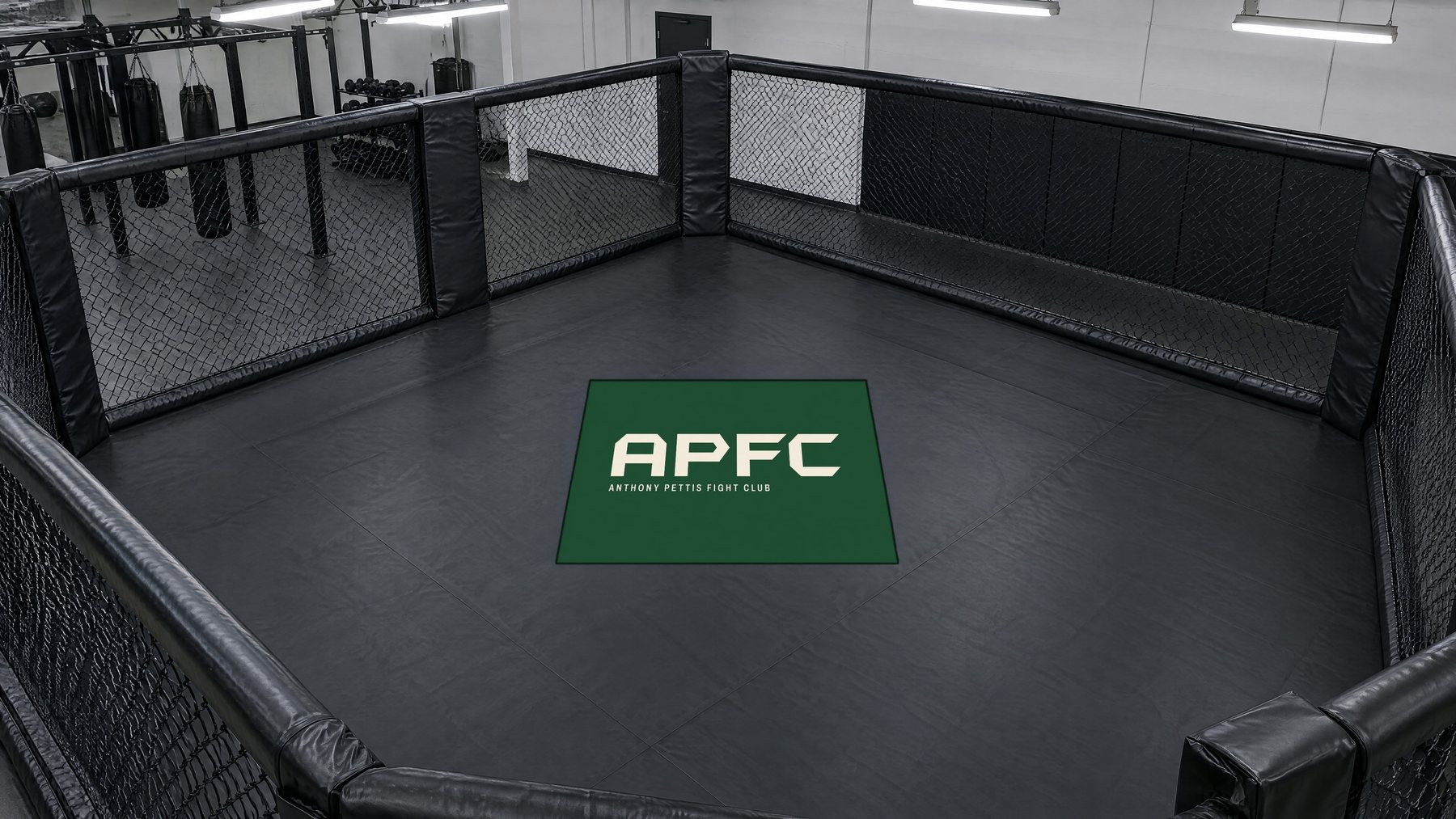
The gym cage

The disciplines

Mixed martial arts

DRAFT 2026-11-04. Facts carry URLs. Level assignments, the ladder map, the class plan and the kids program are PROPOSALS for Anthony Pettis to rule.

One fight. Three ranges. One curriculum.

Mixed martial arts combines grappling, kicking and striking under one rule set, standing and on the ground (Wis. Stat. 444.01(1j), https://docs.legis.wisconsin.gov/statutes/statutes/444; IMMAF amateur rules, https://immaf.org/wp-content/uploads/2025/11/MMA-UNIFIED-RULES-FOR-AMATEUR-JUNIOR-SENIOR-January-2021.pdf). As an educational system it is taught in layers: stance and movement, then striking, takedowns, positions and submissions. Each layer is drilled with a cooperative partner before any live sparring (https://immaf.org/2022/03/21/grading-in-mixed-martial-arts-what-why-how/). Wisconsin and Illinois license or register MMA contestants only at 18 or older (https://docs.legis.wisconsin.gov/document/administrativecode/SPS%20192.06; https://www.law.cornell.edu/regulations/illinois/Ill-Admin-Code-tit-68-SS-1370.710). Children and teenagers train and grade in the art. They compete in the component arts and in no-head-contact formats.

The disciplines

Where it comes from

  1. 648 BC

    Pankration, a Greek combination of wrestling and boxing, was first featured in the 33rd Olympiad.

    en.wikipedia.org
  2. 1899

    Edward William Barton-Wright founded Bartitsu in London, combining catch wrestling, judo, boxing, savate, jujutsu and canne de combat.

    en.wikipedia.org
  3. 1920s

    Vale tudo contests began in Brazil and became known through the Gracie challenge issued by Carlos and Helio Gracie; Brazilian jiu-jitsu developed in Brazil from the 1920s.

    en.wikipedia.org
  4. 1985

    Satoru Sayama founded Shooto in Japan; the first amateur Shooto competition was held in 1986 and the first professional event at Korakuen Hall, Tokyo, in 1989.

    en.wikipedia.org
  5. September 21, 1993

    Pancrase held its first event, Yes, We Are Hybrid Wrestlers 1, at Tokyo Bay NK Hall, Urayasu; Ken Shamrock beat Masakatsu Funaki by choke in the main event.

    en.wikipedia.org
  6. November 12, 1993

    UFC 1 took place at McNichols Sports Arena, Denver; Royce Gracie won the eight-man tournament. Colorado had no athletic commission at the time.

    en.wikipedia.org
  7. November 15, 1993

    Howard Rosenberg's Los Angeles Times review of UFC 1 is, according to Wikipedia, the first documented use in print of the term mixed martial arts; who coined the term is still debated, and the review itself has not been read (see unconfirmed).

    en.wikipedia.org
  8. September 2000

    The New Jersey State Athletic Control Board began allowing MMA promoters to hold events in New Jersey after reviewing their rules.

    nj.gov
  9. January 2001

    The Fertitta brothers bought the UFC for $2 million and created Zuffa, LLC.

    en.wikipedia.org
  10. April 3, 2001

    At a meeting in Trenton the NJSACB, other regulators, promoters and interested parties agreed on a uniform set of MMA rules; the ABC dates its Unified Rules as approved April 2001.

    nj.gov
  11. September 28, 2001

    UFC 33 at Mandalay Bay Events Center, Las Vegas, was the first MMA event sanctioned by the Nevada State Athletic Commission.

    en.wikipedia.org
  12. January 2005

    The Ultimate Fighter premiered on Spike TV.

    en.wikipedia.org
  13. March 27, 2007

    The UFC and Pride announced that the Fertittas would purchase the Pride brand.

    en.wikipedia.org
  14. July 30, 2009

    The Association of Boxing Commissions passed a motion, unanimously, at its annual meeting in New Orleans adopting the New Jersey rules as the Unified Rules of Mixed Martial Arts.

    en.wikipedia.org
  15. February 4, 2010

    2009 Wisconsin Act 111 (Senate Bill 290) was enacted, providing for regulation by the department of amateur and professional mixed martial arts fighting contests.

    docs.legis.wisconsin.gov
  16. December 16, 2010

    WEC 53, Glendale, Arizona: Anthony Pettis beat Benson Henderson by unanimous decision for the WEC lightweight title, landing the fifth-round off-the-cage kick later named the Showtime Kick.

    en.wikipedia.org
  17. February 29, 2012

    The International Mixed Martial Arts Federation (IMMAF) was founded.

    en.wikipedia.org
  18. August 31, 2013

    UFC 164, Milwaukee: Pettis submitted Henderson by first-round armbar to become UFC lightweight champion.

    ufc.com
  19. August 3, 2016

    The ABC amended the Unified Rules; the 2016 package included a new grounded-fighter definition and a foul for fingers extended toward the face.

    abcboxing.com
  20. 2016

    WME-IMG bought the UFC for $4.025 billion.

    en.wikipedia.org
  21. November 12, 2016

    UFC 205 at Madison Square Garden was the first UFC event in New York after the state's professional MMA ban was revoked in early 2016; attendance 20,427, gate $17.7 million.

    en.wikipedia.org
  22. May 2017

    The UFC Performance Institute, a $12 million, 30,000 sq ft facility in Las Vegas, officially opened.

    ufc.com
  23. December 1, 2017

    Wisconsin chapter SPS 192 (Unarmed Combat Sports) was repealed and recreated, effective 12-1-17, with Subchapter V governing MMA at events; Wisconsin uses the ABC weight classes as revised July 26, 2017.

    docs.legis.wisconsin.gov
  24. March 21, 2022

    IMMAF described its MMA grading system: six major youth grades (yellow, orange, green, blue, purple, brown) with mid-grades, black belt only at 18 or older, 230 techniques across ten blocks, a minimum of one year per grade.

    immaf.org
  25. September 12, 2023

    The merger of UFC and WWE into TKO Group was completed.

    en.wikipedia.org
  26. January 30, 2024

    The ABC MMA Rules Committee voted to remove the 12-to-6 elbow as a foul and to redefine a grounded fighter, subject to a full ABC vote at the July 2024 conference.

    combatsportslaw.com
  27. July 23, 2024

    The ABC amended the Unified Rules with these changes, requested implementation November 2024 (the 2024 conference minutes set November 1, 2024); the current text defines a grounded fighter as one with any part of the body other than hands or feet in contact with the canvas.

    abcboxing.com
The disciplines

How it works

  1. One fight, three ranges: MMA is defined as a combination of grappling, kicking and striking, so the art is organized around standing range, the clinch and the ground, and the transitions between them (IMMAF amateur rules definition; Wisconsin s. 444.01(1j)).
  2. Effect over volume: under the ABC judging criteria effective striking is judged by the impact of legal strikes landed, not their number, and effective grappling by takedowns, submission attempts, advantageous positions and reversals; this criterion is weighed before aggressiveness and fighting-area control (ABC MMA Officials Handbook).
  3. Position before submission: the scoring texts reward takedowns that establish an attack, passing to mount, and submission attempts that make an opponent work to escape; a takedown is not merely a change of position (IMMAF 2021 rules). Control positions are taught before finishing holds.
  4. Defense is a scored skill: Illinois judges evaluate effective defense (avoiding strikes, takedowns and reversals while countering), so footwork, guard, parries, the sprawl and guard retention are taught as early as offense (68 Ill. Adm. Code 1370.780).
  5. The rulebook shapes the technique: amateur rules in Wisconsin and Illinois ban elbows, knees to the head, neck cranks, heel hooks and twisting leg locks, so the amateur curriculum is built from what is legal and the professional-only techniques sit at the top of the ladder.
  6. Safety-first progression: IMMAF states the sole ethos of amateur MMA is the safest possible environment under directed pathways; the AAP's guidance for parents is non-contact form and skill development before any sparring or contact, with contact to the head discouraged (healthychildren.org; AAP Care of the Young Athlete handout).
  7. Mechanics first, then live: IMMAF grading assesses biomechanics at every grade and adds live drills with a cooperative partner only at senior grades; a grade is not proof of fighting ability.
  8. The art is cumulative, not a collection of styles: IMMAF's scheme covers 230 techniques across ten blocks with a minimum of one year in each grade.
  9. Endurance is technique: amateur rounds are three minutes and professional rounds five, and a 10-8 round is defined by impact, dominance and duration, so conditioning is a level of the ladder, not an afterthought.
  10. Respect and fair play are rules: the IMMAF youth rules impose zero tolerance for remonstration toward officials and expect a respectful fair play attitude at all times.
  11. Nobody is required to fight: Roufusport, the Milwaukee academy where Pettis trains, states that no student is ever required to fight or spar; training in the art and competing in it are separate choices.

The disciplines

The techniques, by level

34 of 34 techniques

MMA stance

Level 1 Foundation

A squared-up, shorter stance than boxing, weight centered, hands up, chin down, from which a fighter can strike, defend kicks and defend takedowns (https://en.wikipedia.org/wiki/Stance_(martial_arts)).

At APFC
Feet shoulder-width, lead foot forward, knees soft; the coach checks hands, chin and weight before any strike is thrown; mirror work and shadow boxing.

Footwork and pivot

Level 1 Foundation

Stepping and pivoting to change angle and distance while keeping the stance (https://en.wikipedia.org/wiki/Footwork_(martial_arts)).

At APFC
Step-drag in four directions without crossing the feet; pivot on the lead foot; cone drills and no-contact partner mirroring.

Level change

Level 1 Foundation

Bending the knees to drop the hips under an opponent's hands, the entry to every takedown and the base of the sprawl (https://en.wikipedia.org/wiki/Takedown_(grappling)).

At APFC
A squat with the back straight and eyes up, then a penetration step toward a pad, repeated until the student drops without leaning forward.

Clinch and pummeling

Level 2 Technique

Close-range upper-body control with underhooks, overhooks and collar ties, and the swimming of arms for inside position (https://en.wikipedia.org/wiki/Clinch_fighting).

At APFC
Pummeling drill at walking pace for double underhooks; head position before pressure; no clinch strikes until Level 3.

Jab

Level 1 Foundation

The straight lead-hand punch that measures distance and sets up everything else (https://en.wikipedia.org/wiki/Jab).

At APFC
Shadow boxing, then focus mitts: extend and return on the same line with the shoulder covering the chin; the first strike taught.

Cross

Level 1 Foundation

The straight rear-hand punch driven by hip rotation (https://en.wikipedia.org/wiki/Cross_(boxing)).

At APFC
Taught after the jab as the 1-2; the coach watches the rear heel turn and the lead hand stay up; mitts and heavy bag.

Hook

Level 2 Technique

A short bent-arm punch traveling horizontally with the lead or rear hand (https://en.wikipedia.org/wiki/Hook_(boxing)).

At APFC
After the straight punches are stable: elbow at shoulder height, weight through the lead foot; mitts only.

Low kick

Level 2 Technique

A roundhouse kick with the shin to the thigh or calf (https://en.wikipedia.org/wiki/Low_kick).

At APFC
Thai pads and a kick shield: step out at 45 degrees, turn the hip over, strike with the shin; shin guards worn.

Roundhouse kick (body and head)

Level 3 Conditioning

A turning kick striking with the shin at the body or head (https://en.wikipedia.org/wiki/Roundhouse_kick).

At APFC
Body kick to pads at Level 2; head kicks on pads only at Level 3 after flexibility work; head strikes are forbidden at every IMMAF youth level.

Front kick (teep)

Level 2 Technique

A straight pushing or snapping kick with the ball of the foot, used to manage distance (https://en.wikipedia.org/wiki/Front_kick).

At APFC
Chamber the knee, push through the hips, re-chamber; taught on a kick shield as a distance tool before power.

Knee strike

Level 3 Conditioning

A strike with the knee, usually from the clinch, to the body or legs (https://en.wikipedia.org/wiki/Knee_(strike)).

At APFC
Thai pads from a collar tie with hips forward; knees to the head are an amateur foul in Wisconsin (SPS 192.45(12)(c)2) and Illinois (1370.750(a)(11)) and are not taught as a target below Level 5.

Elbow strike

Level 5 Fighter

A short strike with the point or forearm of the elbow, legal only under the professional Unified Rules; since July 2024 the downward 12-to-6 elbow is no longer listed as a foul (https://en.wikipedia.org/wiki/Elbow_(strike)).

At APFC
Not taught below Level 5 because elbow and forearm strikes of any kind are amateur fouls under the ABC amateur rules, IMMAF, Wisconsin and Illinois; professional prospects learn horizontal elbows on pads first.

Ground and pound

Level 4 Competitor

Striking from a dominant ground position (https://en.wikipedia.org/wiki/Ground_and_pound).

At APFC
Drilled on a dummy or pads from mount and guard; strikes to the head of a grounded opponent are a foul in the ABC novice amateur division (fewer than three bouts) and legal in the advanced division.

High guard and blocking

Level 1 Foundation

Hands and forearms covering the head and body against punches and kicks (https://en.wikipedia.org/wiki/Boxing_styles_and_technique).

At APFC
Taught with the stance: slow pad touches from the coach and the student covers; no partner strikes to the head below Level 3.

Parry and slip

Level 2 Technique

Redirecting a straight punch with the hand, or moving the head off its line (https://en.wikipedia.org/wiki/Boxing_styles_and_technique).

At APFC
Partner throws slow jabs to the glove; parry first, then slip outside the jab; progressed to light mitt drills.

Checking the low kick

Level 2 Technique

Lifting the lead shin to meet an incoming leg kick (https://en.wikipedia.org/wiki/Low_kick).

At APFC
Shin guards on both partners: read the hip turn, lift the knee, keep the hands up; drilled at low speed.

Sprawl

Level 1 Foundation

Throwing the hips back and down to stop a shot at the legs (https://en.wikipedia.org/wiki/Sprawl_(grappling)).

At APFC
Solo sprawls on the mat, then against a partner's slow double leg; the first defensive grappling skill taught.

Guard retention and framing

Level 2 Technique

Keeping the legs between you and the opponent from the bottom and using forearm frames to make space (https://en.wikipedia.org/wiki/Guard_(grappling)).

At APFC
From closed guard: hip escape, frames on the hips, re-guard; positional rounds starting from the bottom.

Clinch defense

Level 3 Conditioning

Winning underhooks, framing off and circling out of a wall clinch (https://en.wikipedia.org/wiki/Clinch_fighting).

At APFC
Pummeling with the goal of getting off the fence; taught before clinch striking.

Double leg takedown

Level 2 Technique

A level change, penetration step and drive through both legs (https://en.wikipedia.org/wiki/Double_leg_takedown).

At APFC
Shot drills to a pad, then on a cooperative partner who falls safely; head position (ear to hip) checked every repetition.

Single leg takedown

Level 2 Technique

Controlling one leg and finishing by running the pipe or tripping (https://en.wikipedia.org/wiki/Single_leg_takedown).

At APFC
After the double; the finish drilled on a partner standing on one leg; no lifting finishes for youth (IMMAF youth rules ban suplexes, elevated throws and slams).

Body lock takedown and trips

Level 3 Conditioning

Locking the hands around the waist from the clinch and tripping or turning the opponent down (https://en.wikipedia.org/wiki/Takedown_(grappling)).

At APFC
From the pummeling drill: lock, step, inside trip; partner drilled onto a crash mat.

Hip throw (o-goshi)

Level 3 Conditioning

Turning in and loading the opponent over the hip, a judo throw (https://en.wikipedia.org/wiki/O_goshi).

At APFC
Break-falls first, then the entry with no throw, then the throw onto a crash mat; IMMAF youth rules require throws for the youngest group to be hip-toss variations with head and arm control.

Closed guard

Level 1 Foundation

The bottom position with the legs locked around the opponent's waist (https://en.wikipedia.org/wiki/Guard_(grappling)).

At APFC
Posture control and the hip escape before any submission from guard; positional sparring from guard is the beginner's first live grappling.

Half guard

Level 2 Technique

Bottom position controlling one of the opponent's legs between yours (https://en.wikipedia.org/wiki/Half_guard).

At APFC
Taught as a recovery position: underhook, knee shield, back to full guard or to the feet.

Side control

Level 2 Technique

Top position chest to chest, past the legs (https://en.wikipedia.org/wiki/Side_control).

At APFC
Weight placement and the cross-face before any strikes or submissions; the bottom student learns to frame and recover guard.

Back control

Level 2 Technique

Chest to the opponent's back with hooks in (https://en.wikipedia.org/wiki/Back_mount).

At APFC
Seat belt grip and hooks on a cooperative partner; the beginner learns to protect the neck before learning to attack it.

Rear naked choke

Level 2 Technique

A blood choke from back control with the forearm across the neck (https://en.wikipedia.org/wiki/Rear_naked_choke).

At APFC
Taught slowly with the tap explained first; applied to a partner who taps early; never held after the tap.

Guillotine choke

Level 3 Conditioning

A front choke on the neck with the arm, standing or from guard (https://en.wikipedia.org/wiki/Guillotine_choke).

At APFC
Arm-in version from guard first; IMMAF youth rules ban guillotines entirely at 12 to 13 and allow only arm-in guillotines finished on the ground at 14 to 15.

Armbar

Level 2 Technique

Hyperextension of the elbow with the hips, from guard or mount (https://en.wikipedia.org/wiki/Armbar).

At APFC
From mount first with the partner's arm already extended; pressure applied gradually; the tap is the lesson.

Triangle choke

Level 3 Conditioning

A choke using the legs in a figure-four around the neck and one arm (https://en.wikipedia.org/wiki/Triangle_choke).

At APFC
From closed guard after guard retention is solid; angle and the leg lock drilled before any squeeze.

Kimura (double wristlock)

Level 3 Conditioning

A shoulder lock using a figure-four grip on the wrist (https://en.wikipedia.org/wiki/Kimura_lock).

At APFC
From side control top with slow rotation; wristlocks are banned for youth under IMMAF rules, so it is taught as a shoulder lock only.

Straight ankle lock

Level 4 Competitor

A straight-leg foot lock, the one leg submission the amateur rules leave legal (Wisconsin SPS 192.45(12)(c)4 bans any leg submission except a kneebar or straight ankle lock; the ABC amateur rules allow straight kneebars and straight ankle locks and ban heel hooks and toe holds).

At APFC
Taught at Level 4 with the rule explained; heel hooks and twisting leg locks are not taught to amateurs at all.

The disciplines

The rules

amateur

ABC Amateur MMA Unified Rules: no more than three 3-minute rounds with one minute of rest; three judges; a Novice Division (fewer than three bouts) in which striking the head of a grounded fighter is a foul, and an Advanced Division (more than three verifiable bouts) in which it is legal; fouls for both include elbow strikes of any kind, knees to the head, kicking the head of a downed opponent, heel kicks to the kidney, linear kicks to the knee, neck cranks, all twisting leg submissions (heel hooks, toe holds), spine locks, strikes to the spine or back of the head, small joint manipulation, spiking, fence grabbing, throat strikes, groin attacks; contestants must be 18 on the date of the contest; a ringside physician (MD or DO), an ambulance and two EMTs must be present. IMMAF (January 2021): three 3-minute rounds; forbidden techniques include elbow and forearm strikes, heel hooks, twisters and neck cranks, and knees to the head; categories Senior 18+, Juniors 18 to 20, Youth A 16 to 17, B 14 to 15, C 12 to 13 with no striking to the head or face at any youth level. Wisconsin (SPS 192 Subchapter V): ABC unified rules apply plus additional amateur fouls (elbow or forearm strikes, any knee to the head, neck cranks, any leg submission except a kneebar or straight ankle lock, hand chokes, strikes at or around the knee joint, spinal cranks); a contestant license requires age 18 or older, a physical with HIV and hepatitis B and C screening and an eye exam; amateurs may never have fought professionally (SPS 192.42(5)) and need five recorded amateur bouts on the ABC national database before turning professional, a requirement the commissioner or department representative may waive (SPS 192.42(7)). Illinois (68 Ill. Adm. Code 1370 Subpart F): amateur contestants register with the Division and must be at least 18 with proof of age; non-title bouts are no fewer than three 3-minute rounds with up to a 90-second rest, title bouts three to five rounds, women's bouts three rounds of two to three minutes; 39 listed fouls include elbow strikes, knee strikes to the head, heel hooks or angled leg locks, spine locks, neck cranks, excessive slamming, twisting leg submissions and throwing in the towel; events run under Division-approved sanctioning bodies. There are no youth MMA bouts in either state.

equipment

Gloves of 6 to 8 ounces for amateurs (ABC amateur: at least six ounces; IMMAF, Wisconsin and Illinois: 6 to 8 ounces, supplied by the promoter or host, same weight for both contestants; Wisconsin allows a mitt-style amateur glove); mouthpiece required everywhere, and a round cannot begin without it; groin protector for men; shorts only, no gi or shirt for men, rash guard for women under ABC and IMMAF; no shoes. Shin guards differ: the ABC amateur rules require approved shin guards with instep pads and IMMAF requires pull-on shin guards and rash guards, while Wisconsin bars grappling shin guards and any foot padding for amateurs and Illinois bars knee pads, elbow pads, shin guards, headgear and closed-toe shoes. No rule set here uses headgear in MMA bouts; for context USA Boxing requires headgear in all its divisions (rule 37.3 of the rulebook effective January 1, 2026).

scoring

Three judges on the 10-point must system: the winner of a round receives 10 points and the loser 9 or fewer, 10-10 only in a rare even round. Criteria in priority order (ABC): effective striking/grappling (impact of legal strikes; takedowns, submission attempts, advantageous positions and reversals), then effective aggressiveness, then control of the fighting area, the latter two considered only when the first is even; a 10-8 round is won by a large margin by impact, dominance and duration. Illinois adds effective control, effective aggressiveness and effective defense to its criteria, and judges effective striking by the total number of legal strikes landed (68 Ill. Adm. Code 1370.780). Only the referee may assess a foul; fouls may cost a point; a bout ends by submission (tap or verbal), KO, TKO (referee, physician or injury from a legal technique), unanimous, split or majority decision, draw, disqualification, forfeit, technical draw, technical decision or no contest.

APFC's own rule

There are no youth cage bouts. Wisconsin licenses professional and amateur MMA contestants only at 18 or older (SPS 192.06(2)(a), https://docs.legis.wisconsin.gov/document/administrativecode/SPS%20192.06). Illinois registers amateur MMA contestants only at 18 or older (68 Ill. Adm. Code 1370.710(c), https://www.ilga.gov/commission/jcar/admincode/068/068013700F07100R.html; https://www.law.cornell.edu/regulations/illinois/Ill-Admin-Code-tit-68-SS-1370.710). Members under 18 train and grade in every discipline and compete in the component arts under their own governing bodies.

The disciplines

Ranks and belts

MMA has no universal belt or rank system. IMMAF built a grading scheme because MMA had never had a structured system to evaluate and certify practitioners' levels and criteria vary across the clubs that teach it: six major youth grades (yellow, orange, green, blue, purple, brown), each with a mid-grade; black belt only at 18 or older; a minimum of one year in each grade; 230 techniques across ten blocks; grading by certified coaches, the coach-examiner holding at least Blue+ (the blue mid-grade); assessment mainly biomechanical, with live drills on a cooperative partner at senior grades; a grade is not proof of fighting ability. IMMAF set minimum belts by age band for its 2022 Youth World Championships (the notice's list and prose disagree on which belt applies to which band). The component arts keep their own ranks: IBJJF belts in jiu-jitsu, dan grades in taekwondo under World Taekwondo and USA Taekwondo, and no belts but age and experience divisions in USA Boxing and USA Wrestling.

PROPOSAL for Anthony Pettis to rule; not a governing-body standard

  1. Level 1 Foundation

    White to yellow (stance, footwork, level change, jab, cross, sprawl, closed guard, mount and back escapes; no sparring; graded on mechanics).

  2. Level 2 Technique

    Orange to green (hooks, low kick, body kick, teep, double and single leg, half guard, side control, mount, back control, rear naked choke, armbar; positional grappling, pads only in striking).

  3. Level 3 Conditioning

    Blue (clinch striking to the body, head kicks on pads, triangle, kimura, guillotine, body lock takedowns and hip throws; rounds-based conditioning; light supervised sparring with headgear and shin guards).

  4. Level 4 Competitor

    Purple to brown (ground and pound, straight ankle lock, fight camps; at 18 or older eligible for the ABC novice amateur division, fewer than three bouts and no head strikes on a grounded opponent, then the advanced division).

  5. Level 5 Fighter

    Brown to black, black only at 18 or older as in the IMMAF scheme (elbows, knees to the head and heel hooks taught only here; Wisconsin's five recorded amateur bouts before turning professional, waivable by the commissioner, marks the transition). Under-18 members cannot pass Level 4's bout requirement in Wisconsin or Illinois, so the youth track earns its Competitor level in the component arts (USA Boxing, USA Wrestling, IBJJF, USA Taekwondo events) and in no-head-contact grappling and pad formats.

The disciplines

A class at APFC

PROPOSAL: a class plan for Anthony Pettis to rule; the round lengths and rules cited inside it are sourced

10 min

Warm-up

Jogging, mobility, break-falls, shrimping, shadow boxing. The available evidence on warm-up leans toward lower injury risk though the trials are too few to be conclusive (Fradkin, Gabbe and Cameron 2006, https://doi.org/10.1016/j.jsams.2006.03.026).

5 min

Stance and movement

Footwork and level-change drills in lines; the coach corrects the three points of the stance (hands, chin, weight).

20 min

Technique of the day

One chain of two or three linked techniques (for example jab, cross, double leg; or guard retention, sweep, mount), demonstrated, then drilled on a cooperative partner at low intensity: the IMMAF grading model of mechanics first (https://immaf.org/2022/03/21/grading-in-mixed-martial-arts-what-why-how/).

15 min

Situational rounds

Positional grappling rounds from the day's position and pad rounds for striking; live striking sparring only from Level 3, light, with headgear, mouthpiece, 16 ounce gloves and shin guards, and never required (Roufusport: no student is ever required to fight or spar, https://roufusport.com/).

7 min

Conditioning finisher

Round-length intervals, three minutes on and one off, so the body learns the amateur round (ABC amateur rules, https://abcboxing.com/ABC%20Amateur%20MMA%20Unified%20Rules.pdf).

3 min

Cool-down and log

Stretching, review of the chain, the student's training-log entry toward grading.

The disciplines

For kids

No youth MMA bouts in Wisconsin or Illinois

Wisconsin licenses professional and amateur MMA contestants only at 18 or older (SPS 192.06(2)(a), https://docs.legis.wisconsin.gov/code/admin_code/sps/professional_services/190/192.pdf) and Illinois registers amateur contestants only at 18 or older (68 Ill. Adm. Code 1370.710(c), https://ilga.gov/commission/jcar/admincode/068/068013700F07100R.html ; https://www.law.cornell.edu/regulations/illinois/Ill-Admin-Code-tit-68-SS-1370.710). International youth MMA exists under IMMAF for ages 12 to 17 with no striking to the head or face at any youth level (https://mma.ee/wp-content/uploads/2025/02/IMMAF-YOUTH-Rules-Document-as-of-Jan-2021.pdf), but neither state sanctions it.

The pediatric guidance that governs the design

the AAP clinical report on martial arts (Pediatrics 2016, https://doi.org/10.1542/peds.2016-3022) finds contact-based sparring, competitive training and bouts carry a higher injury risk than noncontact forms and flags head blows and choking or submission moves as the higher-risk activities; the AAP's parent guidance adds that no protective equipment has been shown to prevent concussion and that non-contact form and skill development come before any sparring or contact (https://www.healthychildren.org/English/healthy-living/sports/Pages/Martial-Arts.aspx), and that contact to the head should be discouraged (AAP Care of the Young Athlete handout, https://www.aap.org/globalassets/publications/coya/martial-arts.1.0.pdf); the AAP and the Canadian Paediatric Society oppose boxing for children and adolescents (Pediatrics 2011, https://doi.org/10.1542/peds.2011-1165); the AAP's parent guidance says before age 6 most children lack the motor skills for organized sports and competition should be avoided, at 6 to 9 the focus should be learning skills rather than winning, and at 10 to 12 children can handle complex skills but experts still favor skill development and fun over competition (https://www.healthychildren.org/English/healthy-living/sports/Pages/Is-Your-Child-Ready-for-Sports.aspx).

Ages 3 to 6, movement literacy not fighting (PROPOSAL)

30-minute classes of animal walks, tumbling, break-falls, balance games, pad tapping and simple grappling games; no striking to a partner, no sparring, no chokes or joint locks; a parent in the room (Roufusport's kids MMA program starts as young as 4, https://roufusport.com/).

Ages 6 to 12, the grappling-first curriculum (PROPOSAL)

wrestling positions and escapes, jiu-jitsu positions, pad striking with shin guards, footwork and defense; no head contact of any kind (the IMMAF youth standard applied in training); submissions taught as positions with the tap taught first, following the IMMAF Youth C (12 to 13) rule set that bans grounded striking, knees, guillotines, leg submissions, wristlocks, omoplatas, slams and up-kicks and lets techniques be applied but not finished; competition outlets in USA Wrestling, IBJJF jiu-jitsu and USA Taekwondo events, and USA Boxing's Prep divisions from age 8 (Pee Wee 8 to 10, Bantam 11 to 12, Intermediate 13 to 14, three rounds of 1.5 or 2 minutes, headgear required in all USA Boxing divisions under rule 37.3 of the 2026 rulebook, https://assets.contentstack.io/v3/assets/blteb7d012fc7ebef7f/blt5ff28f6e78e9624d/695ed2d8b45570d8a64b74b9/USA_Boxing_Rule_Book_Revisions_-_1.1.2026.pdf) with the AAP's opposition to youth boxing disclosed.

Ages 13 to 17, the full technique ladder to Level 3 with youth restrictions (PROPOSAL)

the IMMAF Youth B (14 to 15) and Youth A (16 to 17) rule sets are the model for any in-house exhibition (no striking to the head or face, no knees, no slams, no standing guillotines, a single 4-minute round at 14 to 15 and three 2-minute rounds at 16 to 17, 6 to 8 ounce gloves, shin guards, rash guard, groin protector, mouthpiece, post-contest medical); no cage bouts until 18; competition outlets in USA Boxing Junior (15 to 16) and Youth (17 to 18) divisions with headgear, USA Wrestling, IBJJF and USA Taekwondo.

Safety rules for children at the club (PROPOSAL, each tied to a source)

no head contact in any youth class or event (IMMAF youth rules; AAP handout: contact to the head should be discouraged); headgear and 16 ounce gloves whenever body-contact striking is allowed for teenagers (USA Boxing rule 37.3), with parents told that no protective equipment has been shown to prevent concussion (AAP, healthychildren.org); chokes taught but not finished for the youngest group (IMMAF Youth C); a coach on the mat for every pair and no unsupervised live rounds (AAP handout: injuries are prevented with proper supervision and compliance with the rules); no weight cutting, which a 2022 systematic review of youth Olympic combat sports found common and recommended be tightly regulated or banned (https://doi.org/10.1186/s40337-022-00595-w); a concussion stop rule under which any suspected head injury ends the session and the child returns only with medical clearance (AAP handout: athletes with suspected concussions should not return to play until they see a doctor).

The disciplines

Safety, honestly

Competition MMA injury incidence pooled from six studies: 228.7 injuries per 1,000 athlete-exposures (95% CI 110.4 to 473.5); the head was the most commonly injured region (66.8% to 78.0%); losers incurred three times as many injuries as winners; KO/TKO bouts produced more than twice the injuries of submission bouts (Lystad, Gregory and Wilson, Orthop J Sports Med 2014).

doi.org

Match-ending head trauma in the UFC 2006 to 2012: knockouts 6.4 per 100 athlete-exposures and technical knockouts from repetitive strikes 9.5 per 100, a combined 15.9 per 100 athlete-exposures or 31.9% of matches; risk factors were weight class, earlier time in a round, earlier round and older age (Hutchison et al., Am J Sports Med 2014).

doi.org

Nevada professional MMA, September 2001 to December 2004 (171 matches): 28.6 injuries per 100 fight participations or 12.5 per 100 competitor rounds; facial laceration 47.9% of injuries, hand 13.5%, nose 10.4%, eye 8.3%; risk rose with fight length and age (Bledsoe et al., J Sports Sci Med 2006).

jssm.org

Systematic review of 5,374 male and 108 female fighters: weighted average injury rate 246.4 per 1,000 athletic encounters for males; the one study splitting by status reported professionals at 135.5 and amateurs at 71.0 per 1,000 athlete-exposures; the evidence base was judged inadequate for regulators (Thomas and Thomas, Phys Sportsmed 2018).

doi.org

Wisconsin and Arizona ringside physician reports 2018 to 2019: of 503 contests, 57% had at least one injury; match injury rate 68% in professional versus 51% in amateur bouts; amateurs had more contusions and hematomas, professionals more lacerations; losers were injured in 48% of matches versus 24% for winners and had more concussions (Ross et al., Orthop J Sports Med 2021).

doi.org

Training versus competing: a 2023 survey of 112 MMA athletes (41% recreational, 59% competitive) logged 93,857 hours and 127 injuries, 1.4 injuries per 1,000 hours; recreational athletes reported significantly fewer and less severe injuries, and the median burden was zero days of hospitalization and zero days of work incapacity (Groessing et al., Healthcare 2026).

doi.org

Youth: contact-based sparring, competitive training and bouts have a higher injury risk than noncontact forms; head blows and choking or submission moves are the higher-risk activities (AAP clinical report, Pediatrics 2016); the AAP's parent guidance adds that no protective equipment has been shown to prevent concussion and that non-contact form and skill development come before any sparring or contact (healthychildren.org).

doi.org

The AAP and the Canadian Paediatric Society oppose boxing as a sport for children and adolescents and ask physicians to encourage sports that do not make intentional head blows central to play (Pediatrics 2011).

doi.org

Warm-up: of five high-quality randomized trials, three found a significant reduction in injury risk and two did not; the weight of evidence favors lower risk though the authors call it insufficient to endorse or discontinue routine warm-up (Fradkin, Gabbe and Cameron, J Sci Med Sport 2006).

doi.org

Every sanctioned amateur bout under the ABC amateur rules has a ringside physician (MD or DO) at cageside, an ambulance present throughout and at least two EMTs; Wisconsin requires a pre-license physical with HIV and hepatitis B and C screening and an eye exam, plus brain MRI, stress echocardiogram, blood profile and chest x-ray at 40 or older; IMMAF requires a post-contest medical examination.

abcboxing.com

The disciplines

What it gives you

Adults in hard (body-contact) martial arts: a systematic review of 28 studies found mostly positive effects on balance, cognitive function and psychological health; methodological weaknesses across the studies limit the evidence (Origua Rios, Marks, Estevan and Barnett, J Sports Sci 2018).

doi.org

Children: a systematic review of 16 studies (1,615 participants in karate, judo, aikido and taekwondo programs) reported improved physical fitness, especially cardiorespiratory fitness, speed, agility, strength, flexibility, coordination and balance, in preschool and school-age children (Stamenković et al., Children 2022).

doi.org

Youth aggression: a meta-analysis of 12 controlled studies (507 participants, ages 6 to 18) found a medium effect of martial arts training on reduced aggression (0.65, 95% CI 0.11 to 1.03) in the nine intervention and longitudinal studies, with 11 of 12 studies showing a positive impact; the authors call the research base sparse (Harwood, Lavidor and Rassovsky, Aggression and Violent Behavior 2017).

sciencedirect.com

The caution on aggression: a 2026 systematic review of 11 longitudinal studies found no consistent directional effect of martial arts on aggression; the value appears conditional on educational goals, pedagogical guidance and training context, and competitive or dominance-oriented climates may weaken the developmental value of training (Deng, Ma and Luo, Front Public Health 2026).

doi.org

By style: a 2026 network meta-analysis found traditional non-combat martial arts reduced youth aggression versus inactive controls (SMD -0.41) while combat-oriented programs showed weak or non-significant effects; non-competitive programs that build mental discipline had the most consistent evidence (Wang et al., Trauma Violence Abuse 2026).

doi.org

Youth social-psychological outcomes: 27 of more than 350 papers met inclusion; findings conflict between enhanced personal and social opportunities and increased aggressiveness, with the type of guidance and the social context proposed as the deciding factors (Vertonghen and Theeboom, J Sports Sci Med 2010).

pmc.ncbi.nlm.nih.gov

Self-regulation: a meta-analysis of 49 studies (23,098 participants) found universal self-regulation interventions, including four of six exercise-based programs, improved self-regulation in children and adolescents, pooled effect 0.42 (Pandey et al., JAMA Pediatr 2018).

doi.org

Youth with disability: a systematic review of 12 controlled trials (436 participants, mean age 11.4) of Olympic combat sports found significant improvements in stereotypy, communication, social-emotional functioning and executive function (Lee et al., Front Psychol 2025).

doi.org

Recreational MMA is low-cost in injury terms: 1.4 injuries per 1,000 hours of activity, fewer and less severe for recreational than for competitive athletes, with a small economic and healthcare burden compared with other sports (Groessing et al., Healthcare 2026).

doi.org

The disciplines

Anthony and this art

Anthony Pettis was born January 27, 1987, in Milwaukee, began taekwondo and boxing at age 5 and holds a 3rd dan black belt in taekwondo (https://en.wikipedia.org/wiki/Anthony_Pettis, citing Fighters.com); the UFC's athlete page states that he has a third degree black belt in Tae Kwon Do and trains at Roufusport (https://www.ufc.com/athlete/anthony-pettis). He holds a Brazilian jiu-jitsu black belt (GracieMag, January 2020, https://sensobjj.com/blogs/graciemag-1/sergio-pettis-earns-bjj-black-belt); Wikipedia (citing BJJ Eastern Europe) and the UFCalendar database (which dates it 2018, https://www.ufcalendar.com/fighters/anthony-pettis) say it was awarded under Daniel Wanderley, and no primary announcement of the promotion was found. He won the WEC lightweight title at WEC 53 on December 16, 2010, in Glendale, Arizona, by unanimous decision over Benson Henderson, landing the fifth-round off-the-cage Showtime Kick (https://en.wikipedia.org/wiki/Anthony_Pettis ; https://www.sherdog.com/news/news/Pettis-Takes-Title-Bookends-WEC-with-a-Bang-28837), and the UFC lightweight title at UFC 164 in Milwaukee on August 31, 2013, by first-round armbar over Henderson (https://www.ufc.com/news/its-showtime-again-ufc-164-main-event-results); he defended it against Gilbert Melendez by guillotine at UFC 181 (December 6, 2014) and lost it to Rafael dos Anjos at UFC 185 (March 14, 2015). He was the first UFC fighter on the cover of a Wheaties box (UFC.com). Later: a PFL deal announced December 23, 2020, and a Karate Combat 43 win over Henderson on December 15, 2023 (Wikipedia). Wikipedia says he co-owns the Roufusport MMA Academy with Duke Roufus and Scott Joffe, but roufusport.com names Roufus and Joffe as the partners and lists Pettis only as the former champion associated with the gym, so the ownership claim is unconfirmed. His path is the ladder in miniature: a striking base in a belted traditional art, a grappling black belt added, championships in two promotions; the Showtime Kick is a legal technique under every rule set here, and the armbar that won his UFC title is a Level 2 technique in the curriculum.

The disciplines

The glossary

24 of 24 terms

Cage (fighting area)
The fenced enclosure, circular or up to eight equal sides, 16 to 32 feet wide in Illinois, padded, with two gated entrances (68 Ill. Adm. Code 1370.740).
Round
The timed period of fighting: three minutes for amateurs, five for professionals, with one minute of rest (ABC amateur rules; ABC Officials Handbook; Wisconsin SPS 192.52).
10-point must system
The winner of a round receives 10 points and the loser 9 or fewer; 10-10 only in a rare even round (Wisconsin SPS 192.44).
Effective striking/grappling
The first judging criterion: the impact of legal strikes and the results of takedowns, submission attempts, positions and reversals (ABC Officials Handbook).
Grounded fighter
A fighter with any part of the body other than hands or feet in contact with the canvas; may not be kneed or kicked to the head (ABC Unified Rules as amended July 2024).
Foul
A prohibited action such as head butting, eye gouging, strikes to the spine or back of the head, groin attacks, fence grabbing or timidity; only the referee may assess one (UFC unified rules page; ABC rules).
Novice division
The ABC amateur division for fighters with fewer than three bouts, in which strikes to the head of a grounded fighter are a foul (ABC amateur rules).
Tap out
A physical or verbal signal that a contestant no longer wishes to continue, ending the bout by submission (68 Ill. Adm. Code 1370.770).
Technical knockout (TKO)
A stoppage by the referee, on the physician's advice, or by an injury from a legal technique (68 Ill. Adm. Code 1370.770).
No contest
A bout stopped by accidental injury before enough rounds have been completed for a decision (68 Ill. Adm. Code 1370.770).
Weight class
The band a contestant must weigh into, from strawweight (up to 115 lb) to super heavyweight (over 265 lb) (68 Ill. Adm. Code 1370.720).
Stance (orthodox and southpaw)
The ready position; orthodox leads with the left hand and foot, southpaw with the right (https://en.wikipedia.org/wiki/Stance_(martial_arts)).
Level change
Dropping the hips to enter a takedown or to defend one (https://en.wikipedia.org/wiki/Takedown_(grappling)).
Sprawl
Throwing the legs back to stop a takedown attempt (https://en.wikipedia.org/wiki/Sprawl_(grappling)).
Clinch
Standing grappling at close range with underhooks, overhooks and collar ties (https://en.wikipedia.org/wiki/Clinch_fighting).
Guard
The bottom position with the legs between you and the opponent (https://en.wikipedia.org/wiki/Guard_(grappling)).
Mount
The top position astride the opponent's torso (https://en.wikipedia.org/wiki/Mount_(grappling)).
Back control
Chest to the opponent's back with the feet hooked inside the thighs (https://en.wikipedia.org/wiki/Back_mount).
Rear naked choke
The blood choke applied from back control (https://en.wikipedia.org/wiki/Rear_naked_choke).
Ground and pound
Striking from a dominant ground position (https://en.wikipedia.org/wiki/Ground_and_pound).
Teep
The straight front kick used to control distance (https://en.wikipedia.org/wiki/Front_kick).
Check
Lifting the shin to block a low kick (https://en.wikipedia.org/wiki/Low_kick).
Shin guards
Soft leg protection required for amateurs under the ABC amateur and IMMAF rules and prohibited in Wisconsin and Illinois bouts (ABC amateur rules; Wisconsin SPS 192.47(7); 68 Ill. Adm. Code 1370.730).
Grade (IMMAF)
A syllabus level marked by a belt color from yellow to brown, black only at 18 or older; not proof of fighting ability (IMMAF, March 2022).

The disciplines

Frequently asked questions

The disciplines

Sources

125 sources

Book a free class

Book a free class